Rhetoric Day
Summary
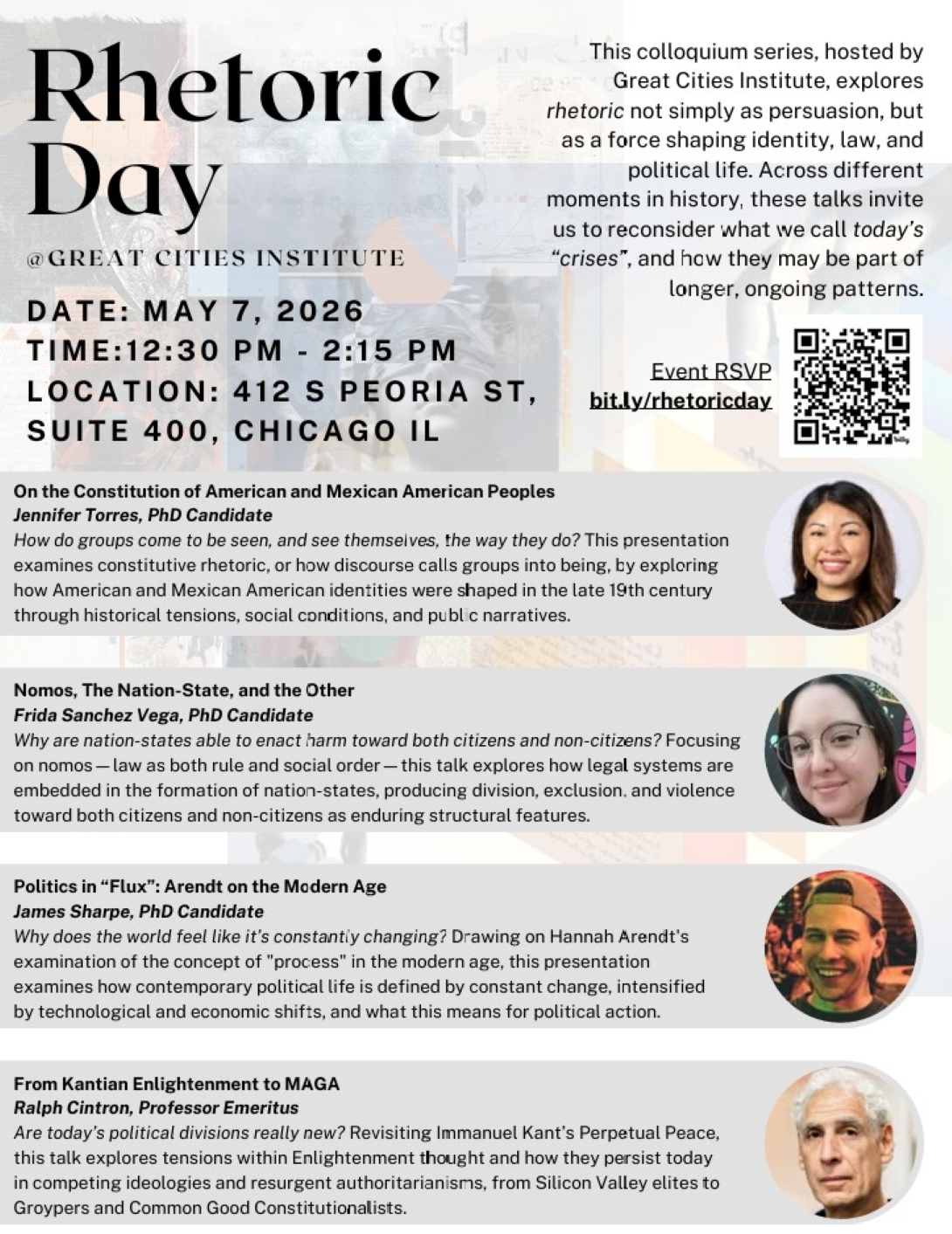
Rhetoric Day at the Great Cities Institute was a dynamic colloquium that brought together emerging scholars and established thinkers to explore rhetoric as more than persuasion—as a force that shapes identity, law, and political life. Held on May 7, 2026, at 412 S. Peoria Street, Suite 400 in Chicago, the event invited attendees to critically engage with how historical and contemporary forces shape the political and social world. By examining rhetoric across different moments in history, the colloquium encouraged participants to reconsider what we define as today’s “crises” and to recognize them as part of longer, ongoing patterns.
Rhetoric Day featured a compelling lineup of presenters whose work spanned rhetoric, political theory, history, and critical social analysis. Together, they brought diverse perspectives on how discourse shapes identity, governance, and contemporary political life.
Jennifer Torres, PhD Candidate, examined how collective identities are formed through language and discourse. Her presentation focused on constitutive rhetoric, exploring how American and Mexican American identities were shaped in the late 19th century through historical tensions, social conditions, and public narratives. Her work highlighted how groups come to understand themselves, and are understood by others, through rhetorical processes.
Frida Sanchez Vega, PhD Candidate, engaged questions of law, power, and the nation-state. Drawing on the concept of nomos—law as both rule and social order—her presentation explored how legal systems are embedded in nation-state formation and how they can produce division, exclusion, and structural harm toward both citizens and non-citizens.
James Sharpe, PhD Candidate, investigated modern political life through the lens of philosophical thought, particularly the work of Hannah Arendt. His presentation drew on Arendt’s concept of “process” in the modern age to examine how contemporary political life is defined by constant change, intensified by technological and economic shifts, and what this means for political action today.
Ralph Cintron, Professor Emeritus, brought a senior scholarly perspective to the event, connecting classical political philosophy with present-day ideologies. His talk revisited Immanuel Kant’s Perpetual Peace to explore enduring tensions within Enlightenment thought and how these tensions continue to shape modern political divisions and resurgent forms of authoritarianism.
Together, the presenters offered a rich, interdisciplinary exploration of rhetoric’s enduring influence across historical and contemporary contexts.