The Whole World is Still Watching
Event Summary
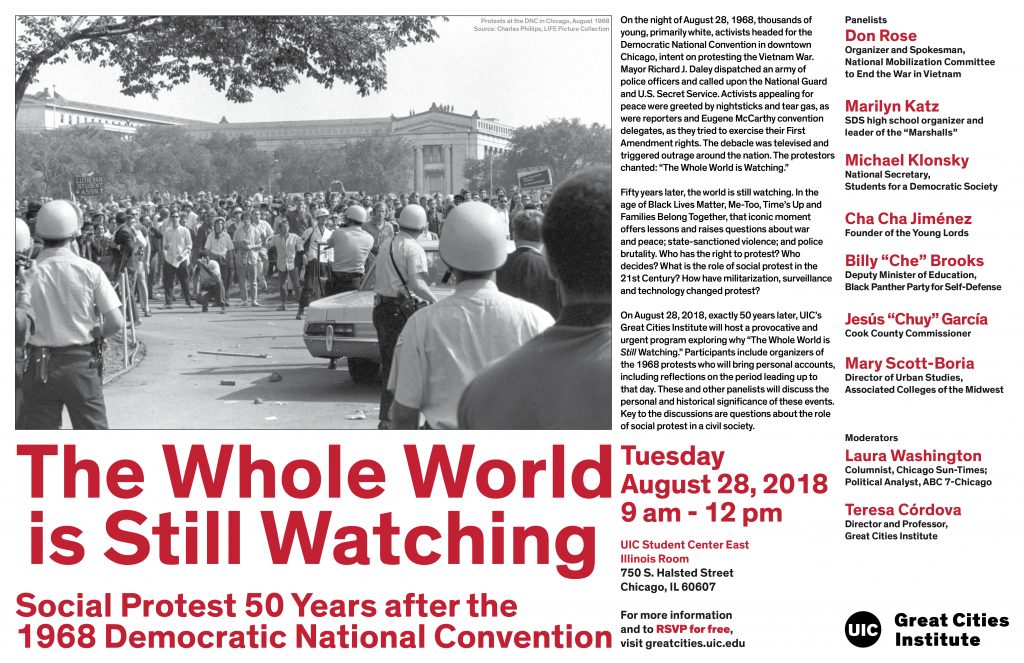
This event marked the 50th anniversary of the 1968 Democratic National Convention protests in Chicago, a defining moment in U.S. history when mass social protest, state violence, and national media attention collided on a global stage. Titled “The Whole World Is Still Watching: Social Protest 50 Years after the 1968 Democratic National Convention,” the program revisited the events of August 1968, when thousands of young people gathered in downtown Chicago to protest the Vietnam War and were met with violent repression by local and federal authorities.
Held on August 28, 2018, at the University of Illinois Chicago, the event brought together organizers, activists, scholars, and public officials to reflect on the political, social, and cultural legacy of the protests. The original demonstrations—televised live as police used nightsticks and tear gas against protesters, journalists, and bystanders—sparked national outrage and left an enduring imprint on debates about free speech, dissent, policing, and democracy. Protesters’ chants of “The whole world is watching” became an enduring symbol of resistance and accountability.
Fifty years later, the program situated the 1968 protests within contemporary movements such as Black Lives Matter, Me Too, immigrant justice organizing, and youth-led activism. Panelists included veterans of the 1960s movements alongside contemporary leaders, offering firsthand accounts of organizing under surveillance and repression, as well as reflections on how protest strategies, state responses, and media technologies have evolved.
Speakers examined critical questions that remain urgent today: Who has the right to protest? How do militarization, surveillance, and criminalization shape dissent? What role does protest play in advancing democracy and social change? The conversation emphasized the intergenerational transmission of movement knowledge and the continued relevance of collective action in challenging war, racism, inequality, and state violence.
Moderated by journalist and political analysts, with leadership from the Great Cities Institute, the event served as both historical reckoning and contemporary call to action—affirming that while the world is still watching, the struggle for justice through organized protest remains as vital as ever.