Climate Justice Meets Global Health in the Time of COVID-19
Event Summary
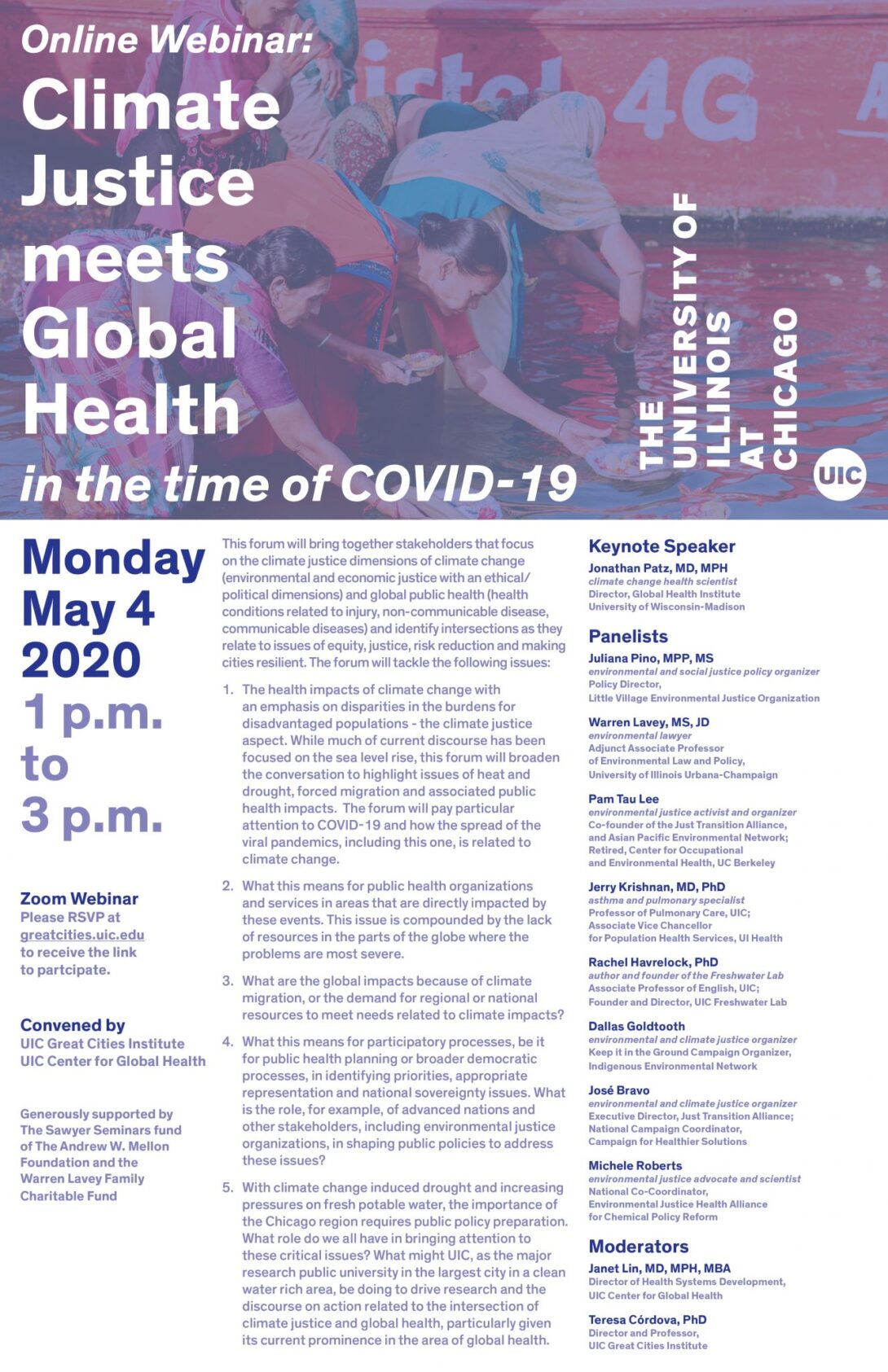
On May 4, 2020, the Great Cities Institute and the Center for Global Health at the University of Illinois Chicago (UIC) convened a webinar forum, “Climate Justice Meets Global Health in the Time of COVID-19,” bringing together scholars, clinicians, and frontline environmental justice leaders to examine how climate change and public health crises converge in cities. The forum emphasized that climate change is not only an environmental issue, but also an ethical, political, economic, and racial justice issue—shaping unequal exposure to pollution, disease risk, and vulnerability during disasters such as the COVID-19 pandemic. Participants explored intersections between environmental and economic justice and global public health, including injury, chronic illness, and infectious disease, with a shared focus on equity, risk reduction, and building resilient cities.
The keynote address was delivered by Jonathan Patz, MD, MPH, Director of the Global Health Institute at the University of Wisconsin–Madison, who framed the pandemic within broader environmental disruption and inequality, highlighting how structural conditions and ecological degradation intensify health harms.
The panel featured leaders and experts across advocacy, law, medicine, and scholarship: Juliana Pino (Little Village Environmental Justice Organization); Warren Lavey (UIUC Environmental Law and Policy); Pam Tau Lee (Just Transition Alliance / Asian Pacific Environmental Network); Jerry Krishnan (UIC Pulmonary Care / UI Health Population Health); Rachel Havrelock (UIC Freshwater Lab); Dallas Goldtooth (Indigenous Environmental Network); José Bravo (Just Transition Alliance / Campaign for Healthier Solutions); and Michele Roberts (Environmental Justice Health Alliance for Chemical Policy Reform).
The discussion was moderated by Janet Lin, MD, MPH, MBA (UIC Center for Global Health) and Teresa Córdova, PhD (UIC Great Cities Institute), reinforcing the forum’s core message: addressing climate change and future public health emergencies requires community-led solutions, accountable policy, and justice-centered urban resilience.