Crossing Latinidades: Climate and Environmental Justice
Event Summary
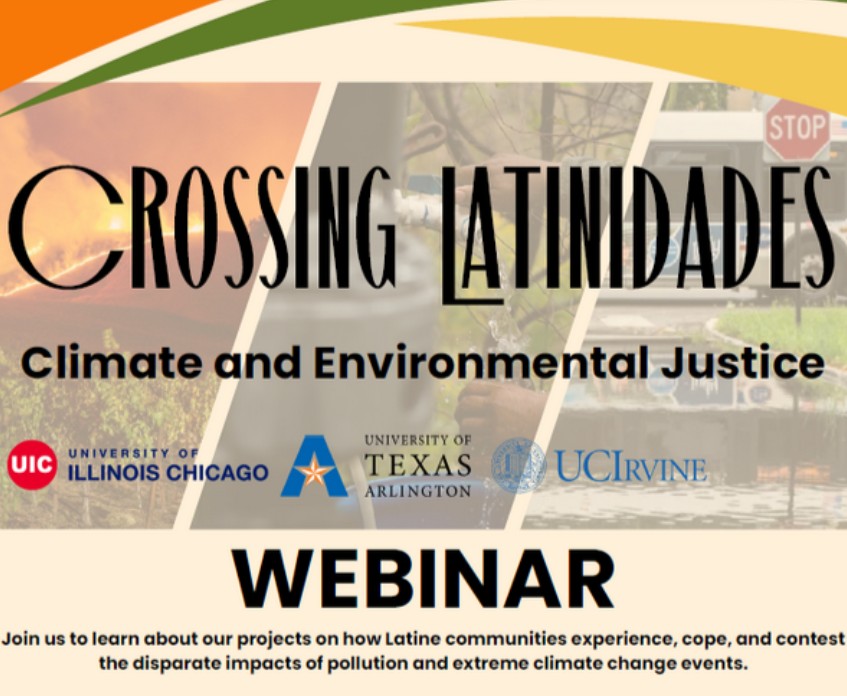
Hosted by the Great Cities Institute at the University of Illinois Chicago, this Crossing Latinidades: Climate and Environmental Justice webinar convenes scholars and community-engaged researchers from three universities to examine how Latino communities across the United States experience, navigate, and resist the overlapping crises of climate change and environmental injustice. Grounded in the belief that those most impacted by environmental harm also hold vital knowledge and solutions, the webinar centers Latino communities as producers of insight, resilience, and collective action.
Funded by the Mellon Foundation’s Crossing Latinidades initiative, this interdisciplinary collaboration features research from five interconnected sites: Chicago, North Texas, Southern California, Illinois’ river corridors, and Puerto Rico. Together, these case studies illuminate the uneven geographies of climate vulnerability while tracing shared histories of displacement, labor exploitation, environmental racism, and resistance. Researchers employ humanistic and participatory methodologies—including oral histories, visual ethnography, story mapping, and long-term community partnerships—to foreground lived experience, memory, and place-based knowledge.
Presentations explore a range of urgent themes, including climate risk in unincorporated Latino communities, the systematic exclusion of undocumented migrants from disaster relief and recovery programs, and environmental racism shaping industrial and logistics corridors on Chicago’s Southeast Side. Speakers also highlight how storytelling, cultural practices, and placekeeping traditions function as critical tools for environmental resilience, political advocacy, and community survival. Transnational perspectives further connect Puerto Rican communities in Chicago with those on the archipelago, revealing how climate displacement, colonial governance, and migration shape shared environmental futures.
Moderated by GCI Director Teresa Córdova, the webinar fosters dialogue across disciplines, geographies, and generations, emphasizing collaboration between scholars and community partners. Ultimately, the conversation reframes Latino communities not as passive victims of environmental harm, but as active agents advancing climate justice, cultural continuity, and more equitable urban and regional futures.