Kerner Report 50th Anniversary Event Series
Event Summary
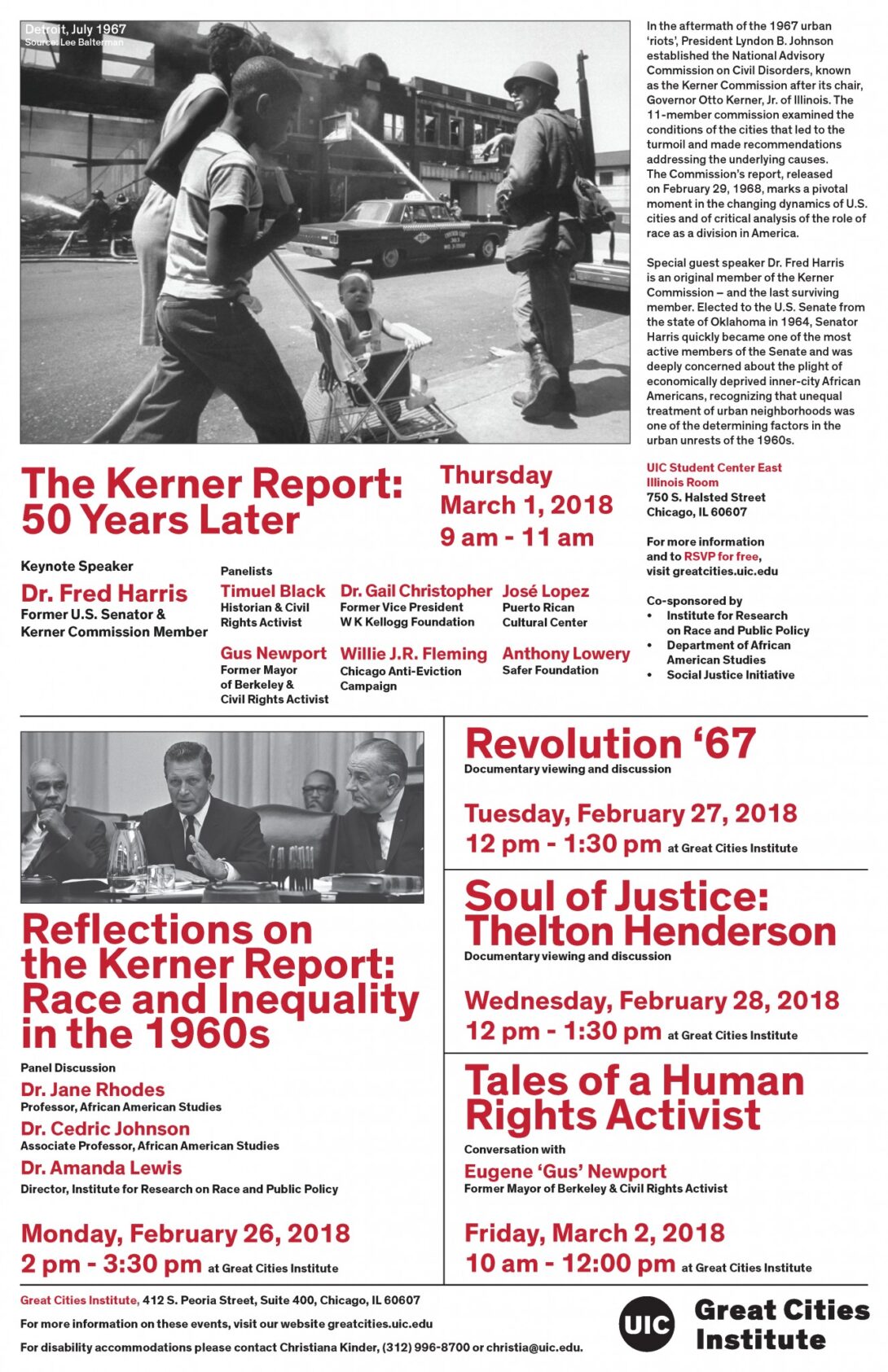
In commemoration of the 50th anniversary of the Kerner Report, the Great Cities Institute at the University of Illinois Chicago presents a weeklong series of events examining the report’s legacy, its historical context, and its continued relevance to racial inequality, urban policy, and social justice in the United States. Issued in 1968 by the National Advisory Commission on Civil Disorders, the Kerner Report famously warned that the nation was “moving toward two societies, one black, one white—separate and unequal.” Fifty years later, its findings continue to resonate amid persistent disparities in housing, employment, education, policing, and political power.
This interdisciplinary series brings together scholars, policymakers, activists, and community leaders to reflect on the conditions that gave rise to the urban uprisings of the 1960s and to assess how structural racism and economic inequality shape contemporary urban life. Through keynote addresses, panel discussions, documentary screenings, and conversations with veteran civil rights leaders, the series highlights both historical analysis and present-day implications.
Featured events include a keynote address by former U.S. Senator and original Kerner Commission member Dr. Fred Harris; panel discussions with leading scholars on race and inequality; documentary screenings exploring the 1967 uprisings and the moral vision of civil rights leaders; and an intimate conversation with longtime activist and former Berkeley mayor Eugene “Gus” Newport. Together, these events invite participants to critically engage with the Kerner Report’s recommendations, evaluate progress and setbacks over the past five decades, and consider pathways toward more equitable and inclusive cities.
This series is co-sponsored by the Institute for Research on Race and Public Policy, the Department of African American Studies, and the Social Justice Initiative, and is open to students, scholars, practitioners, and community members interested in urban justice and racial equity.
Reflections on the Kerner Report: Race and Inequality in the 1960s
Monday, February 26, 2018 | 2:00–3:30 PM
This scholarly panel explores the social, political, and economic conditions that shaped race relations in the 1960s. Faculty experts analyze how systemic racism, urban disinvestment, and public policy intersected during this period and discuss how these dynamics continue to influence contemporary debates on inequality and justice.
Revolution ’67
Tuesday, February 27, 2018 | 12:00–1:30 PM
This documentary screening and discussion revisits the 1967 urban uprisings, offering historical context and personal narratives that illuminate the forces behind one of the most turbulent moments in modern U.S. urban history. The event encourages dialogue on media representation, state response, and community impact.
Soul of Justice: Thelton Henderson
Wednesday, February 28, 2018 | 12:00–1:30 PM
This documentary viewing highlights the life and work of Judge Thelton Henderson, examining the moral courage and legal strategies that defined his career. The discussion reflects on the role of the judiciary in advancing civil rights and confronting systemic injustice.
The Kerner Report: 50 Years Later
Thursday, March 1, 2018 | 9:00–11:00 AM
This keynote and panel event examines the origins, findings, and enduring significance of the Kerner Report. Featuring former U.S. Senator Dr. Fred Harris—an original member of the Kerner Commission—alongside historians, activists, and policy leaders, the program reflects on the structural causes of the 1960s urban uprisings and evaluates the report’s relevance to present-day racial and economic inequality.
Tales of a Human Rights Activist
Friday, March 2, 2018 | 10:00 AM–12:00 PM
In this conversation, civil rights activist and former Berkeley mayor Eugene “Gus” Newport shares reflections on decades of organizing, public service, and advocacy. Drawing from lived experience, the event connects past movements for justice to ongoing struggles for human rights and urban equity.