Latino Environmental Justice Leadership Along Industrial Waterways
Event Summary
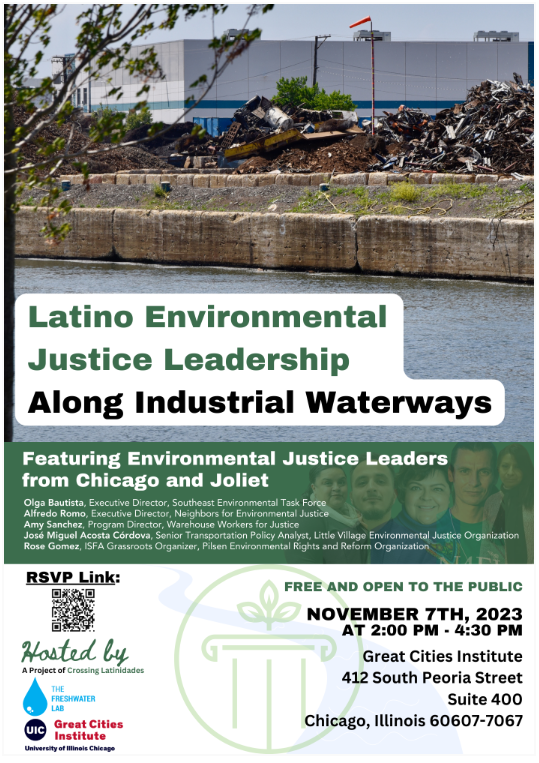
On Nov. 7, 2023, the Great Cities Institute hosted “Latino Environmental Justice Leadership Along Industrial Waterways,” convened by Teresa Córdova and Rachel Havrelock (UIC Freshwater Lab). The forum brought together environmental justice leaders from Chicago and Joliet to share experiences and strategies for confronting environmental racism shaped by industrial waterways, freight systems, and land-use decisions tied to both past and ongoing industrial activity.
Panelists grounded the conversation in lived experience and community histories. Olga Bautista (Southeast Environmental Task Force) described Southeast Side organizing rooted in family migration for steel-mill work and ongoing fights against new extraction and pollution along the Calumet River, including campaigns challenging petcoke and other bulk storage. She emphasized how communities are routinely forced to “prove harm” while industries secure permits, and highlighted grassroots data collection and organizing tactics that helped win enforcement and policy shifts. Rose Gomez (PERRO) traced her path from environmentalism to EJ organizing through the movement to close the Fisk and Crawford coal plants, and described continuing struggles to strengthen monitoring and public accountability for toxic particulate pollution near river-adjacent industrial sites.
José Miguel Acosta Córdova (LVEJO) connected today’s logistics burdens to Chicago’s foundational infrastructure—especially canal development and industrial zoning that followed Indigenous removal and positioned Chicago as a national hub for moving goods. He argued these decisions created long-standing “sacrifice zones,” later intensified by deindustrialization and the rise of warehousing and truck freight. Alfredo Romo (Neighbors for Environmental Justice) described McKinley Park’s encirclement by industrial corridors and diesel traffic, noting how planning patterns modernize North Side corridors while concentrating heavy industry, warehousing, and freight impacts in Southwest and Southeast communities. Amy Sanchez (Warehouse Workers for Justice) detailed Joliet’s rapid logistics expansion as producing overlapping harms—air pollution, water insecurity, infrastructure strain, and precarious warehouse labor—structured by race and class divides.
Together, panelists framed environmental justice as inseparable from labor and health, and emphasized community-led just transition strategies that shift power, protect health, and rebuild local economies without reproducing extractive systems.