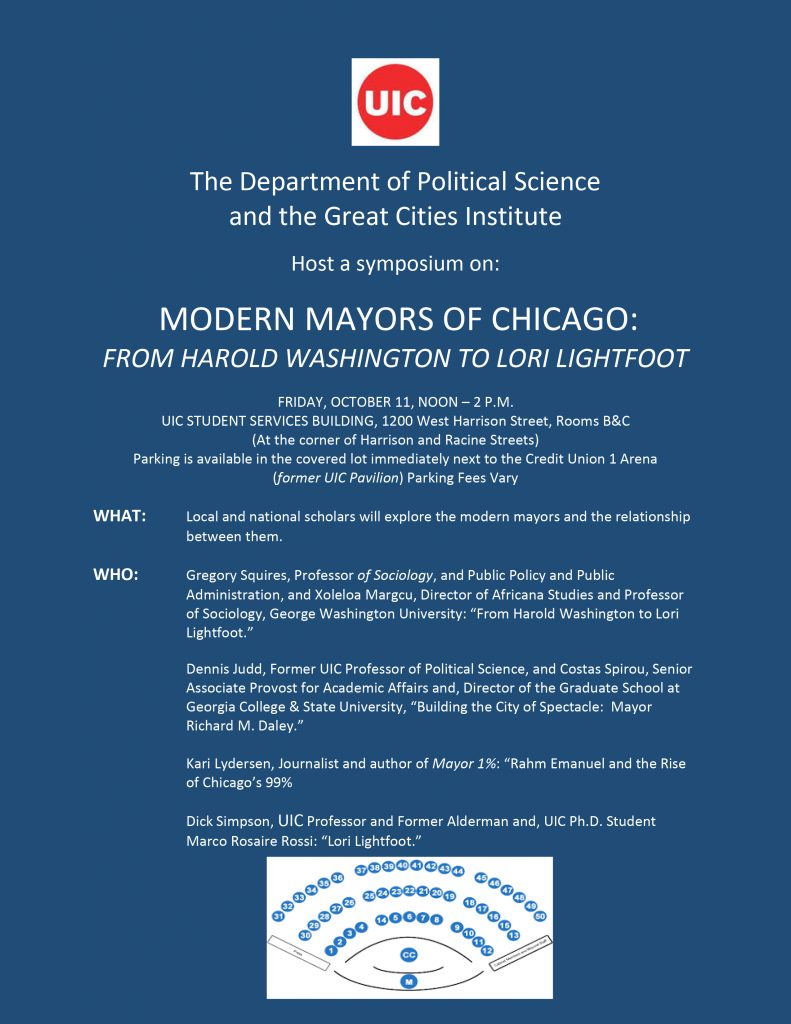
Modern Mayors of Chicago: From Harold Washington to Lori Lightfoot
Posted on October 11, 2019
Event Summary
The symposium “Modern Mayors of Chicago: From Harold Washington to Lori Lightfoot” brought together scholars, journalists, and public intellectuals to examine the political, social, and institutional evolution of mayoral leadership in Chicago over the past four decades. Hosted by the University of Illinois Chicago’s Department of Political Science and the Great Cities Institute, the event explored how successive mayors have shaped—and been shaped by—the city’s racial politics, economic transformations, governance styles, and public expectations.
Beginning with Harold Washington’s groundbreaking election and multiracial coalition, speakers reflected on how Washington redefined democratic participation, reform politics, and community-centered governance in Chicago. His legacy served as a critical reference point for understanding subsequent administrations, including the technocratic and development-driven approach of Richard M. Daley, the neoliberal governance and fiscal restructuring under Rahm Emanuel, and the reform-oriented yet contentious tenure of Lori Lightfoot.
Presentations highlighted both continuity and rupture across mayoral eras, emphasizing how each administration navigated shifting relationships between City Hall, neighborhoods, business interests, and grassroots movements. Panelists examined themes such as racial equity, public accountability, economic development, policing, and political legitimacy, situating Chicago’s mayoral history within broader national debates about urban governance and democracy.
The symposium also foregrounded how structural forces—such as globalization, deindustrialization, austerity politics, and rising inequality—constrained and reshaped mayoral power, regardless of individual leadership styles. By pairing historical analysis with contemporary critique, the discussion encouraged participants to think critically about the limits of executive authority and the importance of civic engagement, coalition-building, and institutional reform.
Overall, the event provided a nuanced, longitudinal perspective on Chicago’s modern mayors, offering insights into how leadership, policy choices, and political context intersect to shape urban futures. It underscored the enduring relevance of Chicago as a lens for understanding race, power, and democracy in American cities.