Natives in Chicago
Event Summary
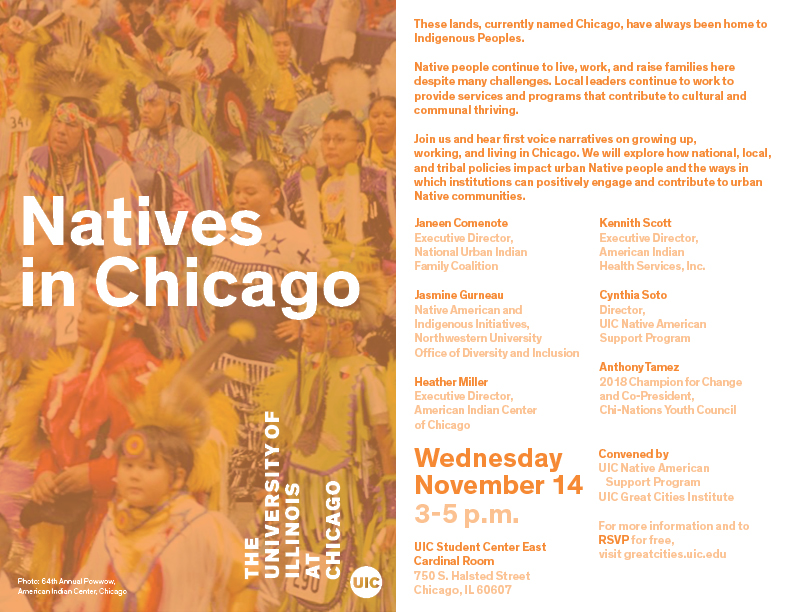
“Natives in Chicago” was a community conversation convened by UIC Great Cities Institute and UIC’s Native American Support Program to uplift Indigenous presence, leadership, and lived experience in Chicago. The event opened “in the spirit of healing” with a land acknowledgement honoring the original peoples of the region, including the Three Fires Confederacy (Potawatomi, Odawa, Ojibwe) and other tribal nations whose relationships to Chicagoland span past, present, and future. Organizers also recognized CAN TV for documenting community events and welcomed Native student leaders and campus partners.
Featured guest Janine Commonout (Quinault Indian Nation), founding Executive Director of the National Urban Indian Family Coalition, traced why so many Native people live in cities—highlighting federal relocation policies and the resulting multi-generational urban Native communities. She described urban Indian centers as culturally grounded “tribal embassies” that provide services across education, employment, housing, and other needs for citizens of many tribes, while also building community and visibility. Commonout emphasized that Native people are often “invisible” in city and national policy conversations despite being disproportionately impacted by systems such as foster care, homelessness, and inequitable access to resources. She shared her coalition’s approach: convening urban centers, hosting policy roundtables with community members and policymakers, and advancing “policy directions” shaped by local priorities like education, transportation, employment, early childhood, coalition-building, and civic engagement.
Panelists then brought the discussion home to Chicago institutions and youth. Jasmine Kern (Northwestern University) outlined efforts to increase Native visibility, strengthen relationships with tribal nations, elevate Indigenous knowledge through research, and support Native students, faculty, staff, and alumni. Heather Miller (American Indian Center of Chicago) discussed the center’s historic role, intertribal community-building, and the challenges of gentrification and displacement. Cynthia Soto (UIC) described the long-standing campus support program and its mission to guide students, connect them to community, and counter persistent erasure. Youth leader Anthony Smith (Chi-Nations Youth Council) highlighted arts, activism, environmental education, and work to end harmful mascots—centering urban Native youth voice, safety, and belonging. The event concluded with audience Q&A on policy, data, identity, and equitable partnership.