Final Report: Options for Chicago’s Financial Future
Summary
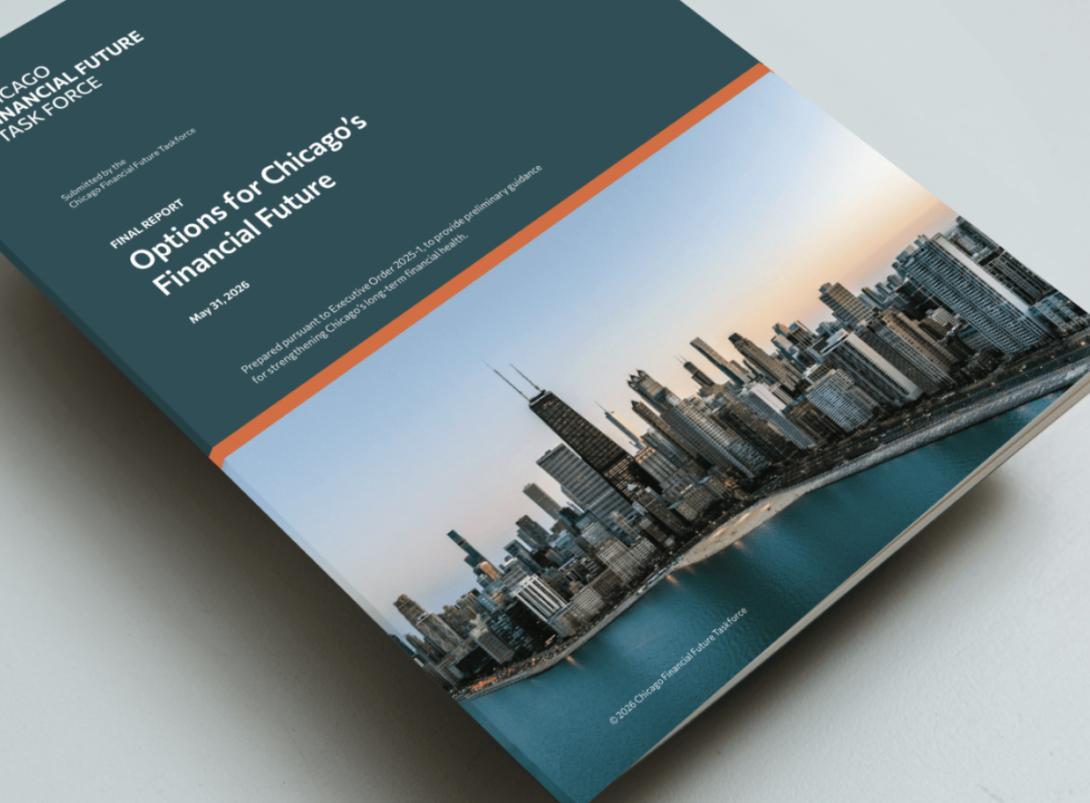
The Chicago Financial Future Task Force’s Final Report examines the long-term fiscal challenges facing Chicago and presents a range of options to support responsible, transparent, and sustainable long-term fiscal decision-making. The report was prepared by an independent, civic-minded Task Force composed of leaders from business, labor, nonprofit, academic, community, and good-government organizations.
The report finds that the City’s budget challenge is structural, meaning recurring expenses continue to grow faster than recurring revenues. Although short-term measures such as federal relief funds, TIF surpluses, hiring freezes, targeted program reductions, and delayed investments have helped balance past budgets, they have not addressed the underlying mismatch between ongoing revenues and expenses. Beginning in FY2027, the Corporate Fund is projected to face a shortfall of approximately $680 million, with longer-term annual gaps estimated at roughly $700 million to $780 million.
What is the Corporate Fund? It serves as Chicago’s main account for day-to-day government operations, including public safety, administrative work, and other essential municipal functions. Separate funds for services such as libraries and airports are financed through their own designated revenue streams and are not included. The report centers on the Corporate Fund because it is the clearest measure of the City’s core operating finances and the area where the ongoing budget imbalance is most visible.
A growing share of the City’s budget is committed to fixed and legacy costs, leaving less flexibility for neighborhood services and future investments. Addressing these challenges will require sustained attention over time rather than one-time actions or short-term fixes. The Final Report does not prescribe a single course of action or advocate for the adoption of specific recommendations. Instead, it offers a menu of options involving cost management, revenue modernization, stronger collections, operational improvements, State-City coordination, and economic growth. These options are intended to help City leaders, stakeholders, and residents better understand the choices, tradeoffs, and long-term implications involved in strengthening Chicago’s fiscal stability and protecting the services people rely on.
Thea Crum, Associate Director of the Neighborhoods Initiative at the Great Cities Institute at the University of Illinois Chicago, served as Chair of the Task Force’s Community Insights Subcommittee, leading the Task Force’s resident engagement strategy. Working with the Subcommittee, she helped design and oversee a process that included 537 survey responses, nine focus groups, and five deliberative town halls across Chicago.
The Community Insights findings were considered alongside the Task Force’s independent fiscal analysis to provide policymakers and the public with a fuller understanding of both the financial challenges and how residents experience them. The engagement findings highlighted concerns about reliable city services, public safety, transportation, affordability, transparency, accountability, and long-term financial stability. They also showed that residents often view fiscal choices through the lens of trust, service quality, and neighborhood impact. Rather than advocating for a single solution, the Community Insights work provides context to help policymakers, civic leaders, and residents better understand the tradeoffs, values, and community priorities that should inform future fiscal decisions.