The Power of Social Enterprises to Reduce Recidivism
October 20, 2026
11:30 AM - 1:15 PM America/Chicago
Location
Maggiano's Banquets
Address
111 W. Grand Avenue, Chicago, IL 60654
Calendar
Download iCal File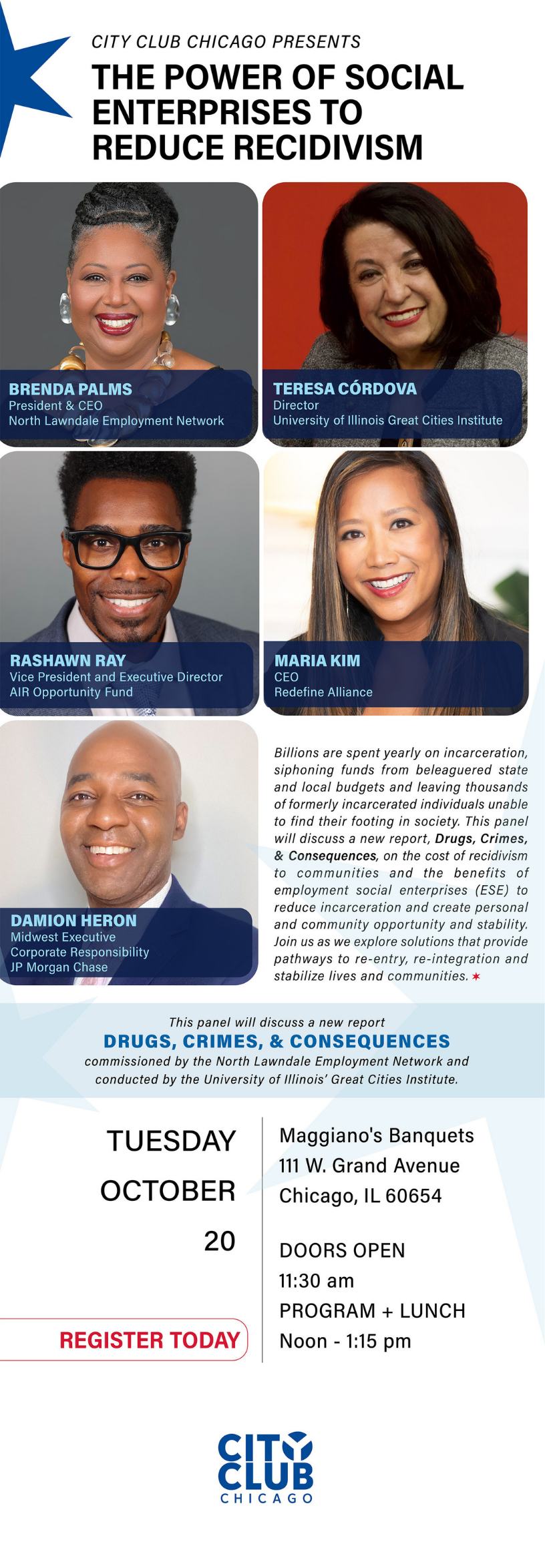
The Great Cities Institute is pleased to join the North Lawndale Employment Network (NLEN) and leaders from the nonprofit, academic, philanthropic, and private sectors for The Power of Social Enterprises to Reduce Recidivism, a City Club of Chicago program examining how employment social enterprises can strengthen pathways to successful reentry while generating broader benefits for individuals, families, and communities.
The discussion will highlight Drugs, Crimes, & Consequences, a new report commissioned by NLEN and conducted by the Great Cities Institute. The report examines the costs of recidivism to individuals and communities and considers the potential of employment social enterprises (ESEs) to reduce incarceration, expand access to meaningful employment, and create pathways toward greater economic opportunity and stability.
At a time when billions of dollars are spent annually on incarceration while formerly incarcerated individuals continue to encounter significant barriers to employment, housing, and long-term economic stability, the panel will explore alternatives that invest in people and communities. Panelists will discuss how employment social enterprises can help disrupt cycles of incarceration by connecting individuals with employment, supportive services, skill development, and opportunities for economic mobility. The conversation will also consider the wider implications of these approaches for public spending, community development, neighborhood stability, and more equitable systems of opportunity.
Bringing together perspectives from community-based economic development, research, social enterprise, philanthropy, workforce development, and corporate responsibility, the program will explore what it means to move beyond reentry as an individual challenge and instead consider the institutional and community conditions necessary for people to successfully rebuild their lives.
Speakers
Brenda M. Palms is the founding President and CEO of the North Lawndale Employment Network (NLEN) and the visionary behind Sweet Beginnings, LLC, an employment social enterprise that creates economic opportunities for people facing significant barriers to employment, including individuals impacted by the criminal legal system. For more than 25 years, Palms has advanced innovative approaches to workforce development, fair-chance employment, and community revitalization. Her leadership has helped demonstrate how social enterprise can simultaneously create employment opportunities, strengthen communities, and challenge systemic barriers that prevent people from fully participating in the economy.
Teresa Córdova is Director of the Great Cities Institute (GCI) at the University of Illinois Chicago (UIC) and Professor of Urban Planning and Policy in UIC's College of Urban Planning and Public Affairs. Her work focuses on community and economic development, university-community partnerships, engaged research, and the relationship between global economic restructuring and local communities. Throughout her career, Dr. Córdova has worked closely with community organizations and institutional partners to connect academic research with policy analysis, program development, and strategies for addressing complex urban challenges.
Rashawn Ray is Vice President and Executive Director of the AIR Opportunity Fund, a 10-year initiative supporting locally driven and evidence-informed approaches to persistent disparities in education, workforce development, public safety, and community health. He is also a professor at the University of Maryland and a senior fellow at the Brookings Institution. Dr. Ray's scholarship examines racial and social inequities, with particular attention to criminal justice reform, policing, health policy, and economic disparities. His work spans academic research, public policy, community engagement, and applied initiatives designed to translate research into institutional and social change.
Maria Kim is CEO of Redefine Alliance, a national venture catalyst supporting social enterprises that create economic mobility for people overcoming significant barriers to employment. Previously, she served as CEO of Cara Collective, where she helped advance employment and economic opportunities for individuals experiencing homelessness and poverty. Kim has served in numerous national advisory and leadership roles focused on entrepreneurship, social enterprise, small-business development, and economic mobility, bringing extensive experience in connecting business strategy with social impact.
Damion Heron is a corporate responsibility executive at JPMorgan Chase, where he leads the firm's public engagement strategies across a fourteen-state region. His work brings together philanthropy, community and economic development, public affairs, and partnerships intended to strengthen communities and expand economic opportunity. Over the course of his career, Heron has held leadership roles across the corporate, public, and civic sectors, including positions with The Boeing Company, the Chicago Office of Emergency Management and Communications, and Britain's House of Commons. He is also active in Chicago and Illinois civic leadership and has served with numerous organizations focused on community development, philanthropy, and public policy.
Event Details
Tuesday, October 20, 2026
Doors Open: 11:30 a.m.
Program + Lunch: 12:00 p.m. - 1:15 p.m.
Maggiano's Banquets
111 W. Grand Avenue
Chicago, IL 60654
Registration is required, and seating is limited.
Date posted
Aug 21, 2026
Date updated
Aug 21, 2026