Gordon Parks and the Postwar City Conference
Summary
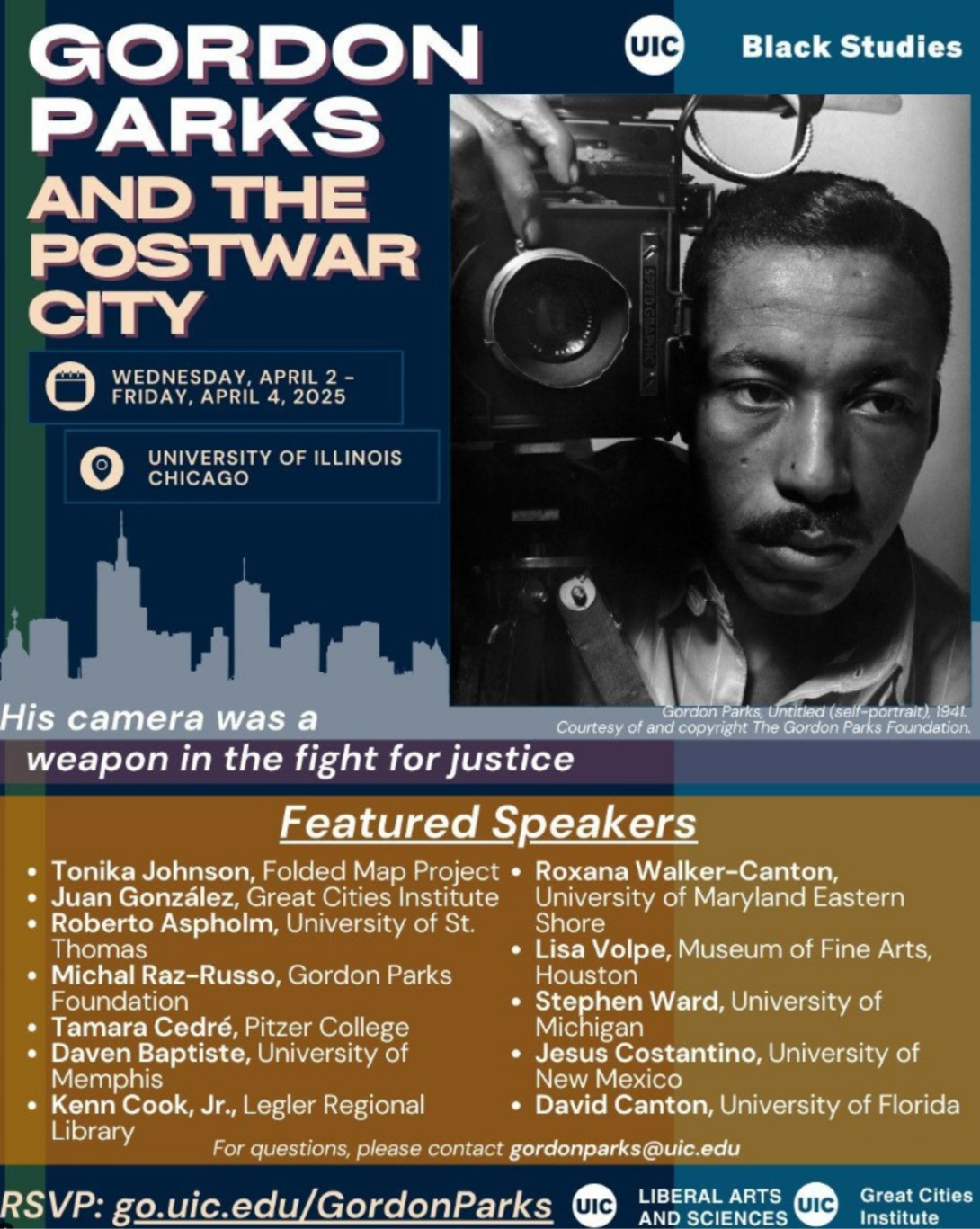
The University of Illinois Chicago’s (UIC) Black Studies Department hosted the Gordon Parks and the Postwar City Conference, a three-day gathering held April 2–4, 2025, at the UIC Great Cities Institute (GCI) and Richard J. Daley Library. Bringing together scholars, filmmakers, artists, students, and community activists, the conference examined the life, artistic contributions, and enduring legacy of Gordon Parks, one of the most influential Black photographers and filmmakers of the twentieth century. Through film screenings, scholarly presentations, and panel discussions, the conference explored Parks’s documentation of Black life in postwar America, with particular attention to urban transformation, racial inequality, policing, poverty, civil rights, Black Power, and the relationship between artistic expression and social change.
Born in Kansas in 1912, Parks spent his formative years in St. Paul, Minnesota, before moving to Chicago in 1940. Chicago played a pivotal role in his artistic development, as he established his first portrait studio at the South Side Community Art Center and was subsequently recruited to the Farm Security Administration. These experiences helped shape his belief in the camera as a powerful instrument for confronting social injustice. Throughout his career, Parks documented the experiences of marginalized communities, challenged prevailing racial stereotypes, and brought greater visibility to the political and social realities of Black Americans. His photography and films captured the complexities of urban life, including the consequences of segregation, economic hardship, racial discrimination, and the evolving political aspirations of Black communities.
The conference opened on April 2 at the Great Cities Institute with a screening and discussion of The World of Piri Thomas, featuring panelists Teresa Córdova and Juan González of UIC Great Cities Institute, Tamara Cedré of Pitzer College, and Donn Worgs of Towson University. The opening event provided an opportunity to engage with themes of urban marginalization, racial identity, and the representation of communities navigating social and economic inequality.
On April 3, the conference continued at UIC’s Richard J. Daley Library with an opening plenary featuring Cedric Johnson of UIC, Roberto Aspholm of the University of St. Thomas, and Michal Raz-Russo of The Gordon Parks Foundation. Subsequent sessions examined Parks’s artistic practice and political engagement. The session titled Black Life South & North featured presentations by David Canton of the University of Florida on the relationship between Black artistic expression and objectivity, and Jesus Costantino of the University of New Mexico on race, color photography, and visual representation in Parks’s work. Cynthia Blair and Ainsworth Clarke of UIC served as discussants. The afternoon session, Black Power, explored Parks’s representations of prominent political figures and movements, including presentations by Stephen Ward of the University of Michigan on Malcolm X and Lisa Volpe of the Museum of Contemporary Arts Houston on Parks’s work involving Stokely Carmichael and the Vietnam War. Jane Rhodes and Johari Jabir of UIC served as discussants.
The final day, April 4, returned to the Great Cities Institute for three sessions examining the intersections of urban life, labor, cinema, and social justice. The morning session, Working Life at the Margins, featured Cedric Johnson of UIC presenting “In Twilight and Shadow: Seeing Mid-Twentieth Century Working Lives with Gordon Parks” and Roberto Aspholm of the University of St. Thomas presenting “Crime in Gordon Parks’s Postwar City.” With Julian Thompson and Lilia Fernandez of UIC serving as discussants, the session examined how Parks’s work illuminated the experiences of working-class communities and the social conditions shaping life in American cities during the mid-twentieth century.
The second session, Blaxploitation Cinema, considered Parks’s contributions to filmmaking and the cultural politics of Black representation in American cinema. Roxana Walker-Canton of the University of Maryland Eastern Shore presented “You’re Damned if You Do and Damned if You Don’t: Afropessimism and Respectability Politics in Gordon Parks’ The Learning Tree,” while Daven Baptiste of the University of Memphis presented “Shaft: A Black Power Double Feature… Ya Dig!” David Stovall and Faheem Majeed of UIC served as discussants, contributing perspectives on the relationship between film, Black cultural expression, political identity, and social critique.
The conference concluded with A Choice of Weapons, a panel discussion featuring Tonika Johnson of the Folded Map Project, Kenn Cook Jr. of the Legler Regional Library, Michal Raz-Russo of The Gordon Parks Foundation, and Jimel Primm of Primm’s Positive Space. Drawing on Parks’s understanding of photography and visual storytelling as tools for social change, the concluding session brought together individuals working across artistic, cultural, and community contexts. The discussion connected Parks’s legacy to contemporary approaches to documenting communities, challenging inequities, and advancing public engagement through creative expression.
By examining Gordon Parks’s work across photography, journalism, and cinema, the conference highlighted the continuing relevance of his artistic vision for understanding the relationship between race, urban development, inequality, and political struggle. The event also underscored Chicago’s historical significance in Parks’s career and its broader role in shaping Black artistic and intellectual life. Through its participation as a conference venue and the contributions of its affiliated scholars, the Great Cities Institute supported interdisciplinary dialogue connecting historical scholarship, cultural production, and contemporary questions of urban life and social justice.