Chicago Development Program Left Poor Areas Behind, Study Says
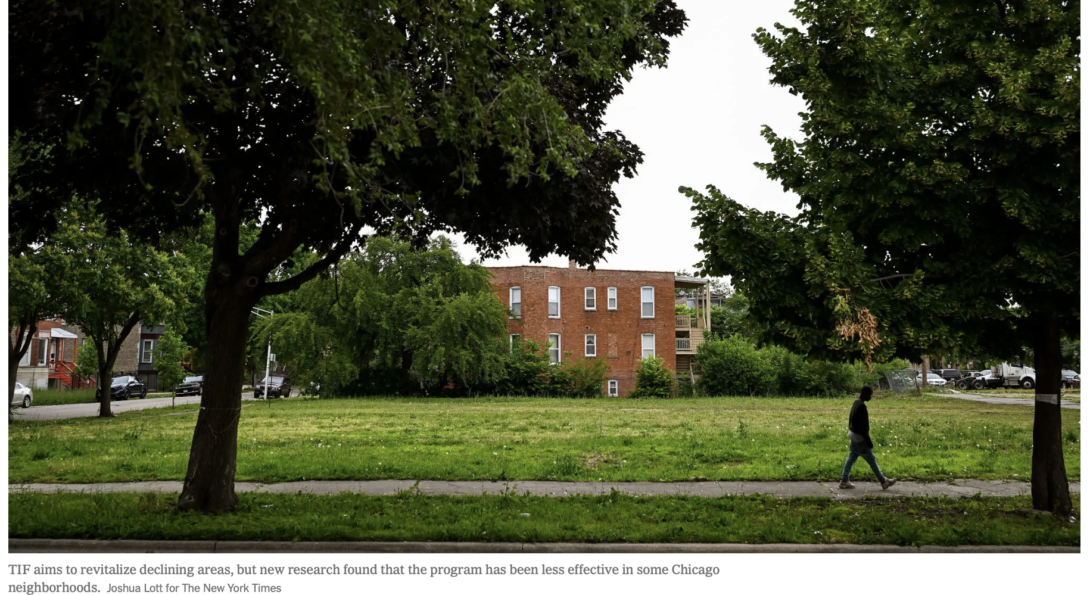
New research suggests that TIF, a multibillion dollar tax program intended to revive the city’s blighted neighborhoods, has mostly benefited downtown areas.
Summary
“A program that has successfully helped revive Chicago’s once downtrodden downtown has been less effective in the city’s poorer neighborhoods, including many on the South and West Sides, asweeping study published Wednesday found.
Authorized by state lawmakers more than 40 years ago, the tax increment financing program, or TIF, aims to revitalize struggling neighborhoods by stimulating economic development. When the city designates a TIF district, it freezes the assessed property values in that area for at least 23 years. Any future extra tax revenue generated from rising property values is earmarked in a TIF fund and reinvested in the development of that same or surrounding area.
The money can be used for the construction of parks, schools and infrastructure, as well as incentives for private commercial and residential development. As the theory goes, projects funded by TIF cause the value of the surrounding properties to rise, fueling more growth.
But the new study argues that nearly all of the increases in property values would have occurred organically, without the program.
“Chicago has utilized this program far more than any other major American city,” said Juan González, a senior research fellow with the Great Cities Institute, an economic research hub at the University of Illinois Chicago that published the study. “Over the decades, the program morphed into a runaway development tool with little accountability to the public.”
The researchers spent more than a year analyzing Chicago’s use of TIF since the program was first implemented in the city’s downtown in 1984, reviewing contracts and creating a data set that included property assessments and tax rates. The analysis relied on publicly available data, which spanned different time periods and contained errors and gaps.
The program has thrived as intended downtown, now brimming with offices and restaurants. But the researchers found that it has been less successful in poorer areas, which have largely failed to see transformative change, partly because of decades of underinvestment.
Among the funds the researchers were able to track was $9.4 billion allocated for a mix of 1,427 public and private development projects across the city. Of nearly $2.6 billion in TIF funds used on private projects, 64 percent — around $1.6 billion — was allocated to five neighborhoods in and around downtown.
The researchers estimated that five communities on the South and West Sides received $55 million in TIF funds for private projects, barely half as much as the Near North Side, the lowest recipient among the downtown neighborhoods.
Downtown communities didn’t only benefit from private development. The researchers also found that almost half of TIF spending they tracked since 1986 for projects such as affordable housing, parks and roads was also concentrated in and around downtown.
“Instead of reducing the city’s historic economic inequities, it has exacerbated them,” Mr. González said.
Jan Brueckner, a professor of economics at the University of California, Irvine, who developed a model on TIF’s effects on public services in Illinois two decades ago, said the research was “well done.” Mr. Brueckner, who was not involved with the study, emphasized that TIF districts “collect tax revenue generated by improvements, as intended, but also keep revenue from overall property-value inflation, which is then not available to the city.”
Supporters of TIF have long argued that the program generates private investment, jobs and increased property value that would not have otherwise occurred.
But the researchers compared the change in value for properties that were closest to TIF projects to values for properties that were farther away. They found little difference, estimating that over 98 percent of the increase in property value within TIF districts would have happened without the program.
William Fulton, an urban studies professor at the University of California, San Diego, and a former San Diego city planner, who was not involved with the study, cautioned that the comparison was not an “apples to apples,” and that the 98 percent figure was likely inflated.
“What it assumed is that the parcels in or near the TIF and the neighborhoods in or near the TIF are exactly the same as the parcels in the neighborhood a little further away, which may or may not be true,” he said.
Critics argue that TIF diverts tax revenue that could have otherwise gone to local agencies, such as public school systems, fire and police departments and park districts, which have to divide up the amount of property tax frozen before a TIF area is designated.
The researchers concluded that homeowners faced higher property tax rates over time to make up for the diverted revenue. Researchers assumed that if the city had access to that revenue and applied the funds for basic services, property tax rates would not have increased as much. They estimated that a Chicago homeowner with a $300,000 home paid $878 in 2023 to make up for the amount of property tax revenue diverted to TIF. Overall, researchers estimated the homeowner paid $6,616 from 2014 to 2023.
To calculate how much revenue was diverted to TIF and its possible effect on local agencies, the researchers analyzed tax bills from some of downtown’s most valuable properties.
Google’s Midwest headquarters, for example, paid $7.6 million in property taxes in 2025, of which 98.2 percent was funneled into a local TIF account. The rest of the tax revenue was divided and distributed among local city services.
The share of tax revenue that Chicago Public Schools received in 2025 was $73,126, equivalent to roughly one teacher’s salary.
The researchers did not recommend eliminating the program. But they suggested a handful of reforms, including implementing independent oversight and reducing the amount of property tax revenue diverted from basic city services.
They also suggested that the city phase out downtown TIF districts that have accomplished their goals, so local agencies could collect more tax revenue.
“There is no question that TIF is a powerful but flawed and inequitable tool for economic development,” Griffin Krueger, a spokesman for Mayor Brandon Johnson, wrote in a statement.
The Johnson administration says it is moving away from relying on the program to spur development. Mr. Krueger pointed to a $1.25 billion Housing and Economic Development bond that he said would be a “long-term source of flexible, equitable funding.”
When a TIF district expires, the tax revenue it holds goes back to local agencies. A portion of that revenue will help to fund the bond, which was approved in 2024.
The bond program aims to invest up to $3 billion across Chicago by 2028. The city says the program will prioritize affordable housing and commercial projects on the South and West Sides.”
By Nell Salzman
Nell Salzman is reporting on economic development in Chicago as part of The Times’s Local Investigations Fellowship.
Aug. 26, 2026