Join Us for Three Upcoming GCI Events
Summary
We hope that you are having a great summer and have been able to enjoy some down time and the many things that summer in Chicago has to offer.
Great Cities Institute continues to convene and support programs that bring together public officials, community members, scholars, practitioners, and students around questions of equity, history, urban development, and the institutions and policies that shape everyday life.
We invite all of you to join us for three upcoming events.
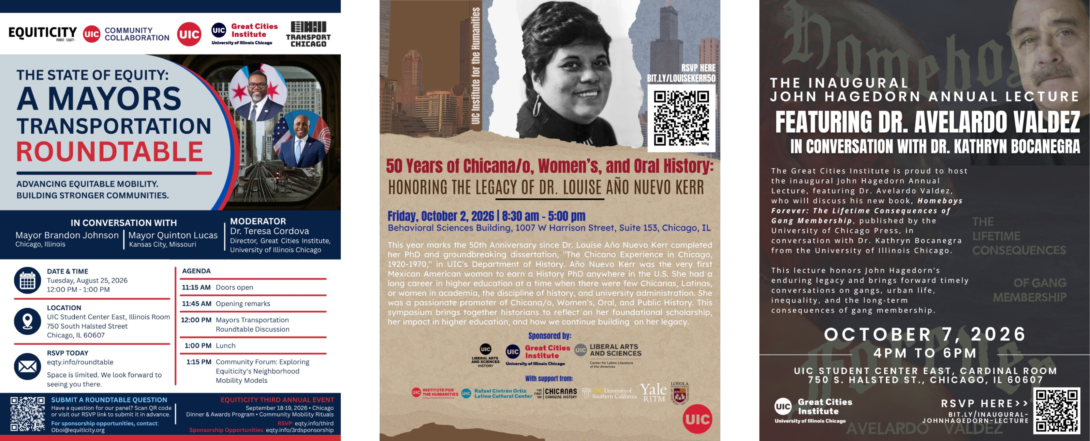
Tuesday, August 25, 2026
Questions of transportation are also questions of access: access to employment, education, health care, public space, neighborhood institutions, and the broader opportunities that cities make possible.
The State of Equity: A Mayors Transportation Roundtable, co-sponsored by Equiticity, University of Illinois Chicago (UIC), UIC Community Collaboration, Great Cities Institute, and Transport Chicago, will bring together Mayor Brandon Johnson of Chicago and Mayor Quinton Lucas of Kansas City, with the conversation moderated by Dr. Teresa Córdova, Director of the Great Cities Institute. The discussion will examine how cities can address transportation inequities, strengthen connections between neighborhoods, and build mobility systems that are more accessible, inclusive, and responsive to community needs.
On March 17, 2021, GCI partnered with the University of California, Berkeley’s Institute for the Study of Societal Issues, which is celebrating its 50 year anniversary in October, to host the Black Mayors & Leadership in the United States series, continuing a broader conversation about how local leadership can confront structural inequality and shape more equitable urban futures. A community forum focused on Equiticity’s neighborhood mobility models will extend the discussion by considering community-centered approaches to transportation and mobility.
Friday, October 2, 2026
Honoring the Legacy of Dr. Louise Año Nuevo Kerr: 50 Years of Chicana/o, Women’s, and Oral History is a daylong symposium sponsored by UIC’s Department of History, Great Cities Institute, and the Center for Latinx Literature of the Americas, with support from the UIC Institute for the Humanities, Rafael Cintrón Ortiz Latino Cultural Center, The First 100 Years of Chicanas Changing History, the University of Southern California, Yale University’s Center for the Study of Race, Indigeneity, and Transnational Migration, and Loyola University Chicago.
Fifty years ago, Dr. Louise Año Nuevo Kerr completed The Chicano Experience in Chicago, 1920–1970 in UIC’s Department of History, producing foundational scholarship on Mexican life in Chicago and helping establish new possibilities for Chicana/o, women’s, oral, and public history.
Dr. Kerr was the first Mexican American woman in the United States to earn a PhD in History. Across her career, her scholarship and leadership helped broaden whose histories were documented, whose experiences were recognized as central to the study of cities and institutions, and who could see themselves represented within the academy.
This daylong symposium will bring together historians, scholars, students, and community members to reflect on Dr. Kerr’s foundational scholarship, her influence on higher education, and the continuing importance of historical work rooted in communities whose experiences have too often been marginalized within traditional academic narratives.
The gathering also builds upon the 2016 Mexicans in Chicago: Honoring the Legacy of Dr. Louise Año Nuevo Kerr Conference. Fifty years after the completion of Dr. Kerr’s dissertation, the symposium offers an opportunity not only to recognize her accomplishments, but also to consider the continuing intellectual and public significance of scholarship that documents communities, preserves histories, and creates new foundations for research and engagement. This commitment to documenting Latino communities, preserving their histories, and advancing scholarship grounded in their experiences continues through GCI’s Latino Research Initiative.
Wednesday, October 7, 2026
The Great Cities Institute will host the Inaugural John Hagedorn Annual Lecture, establishing a new annual program honoring the life, scholarship, and lasting intellectual contribution of Dr. John Hagedorn.
Hagedorn’s work challenged conventional understandings of gangs, violence, urban inequality, and marginalized communities. Rather than treating gangs simply as manifestations of crime or individual behavior, his scholarship situated them within the larger social, political, and economic conditions that shape cities and the lives of the people within them. GCI previously hosted Hagedorn for “Gangs on Trial,” a public forum in 2022 examining how gang labels, stereotypes, and dehumanizing narratives can shape courtroom outcomes and obscure the broader structural conditions surrounding the lives of justice-involved youth. In 2024, GCI also hosted “Honoring the Life and Work of John Hagedorn,” bringing together family, friends, students, colleagues, and community partners to reflect on his legacy as a scholar, activist, mentor, and organizer.
Hagedorn’s work was also part of a broader intellectual lineage shaped by Joan Moore, his mentor and former professor, whose pioneering research helped transform the study of gangs and Latino communities. GCI highlighted this connection in its 2020 program “Honoring Joan Moore Through Her Students,” which brought together scholars influenced by Moore’s work, including John Hagedorn and Avelardo “Lalo” Valdez.
That intellectual lineage continues with Dr. Avelardo Valdez, Professor Emeritus at the University of Southern California, who will deliver the inaugural John Hagedorn Annual Lecture in conversation with Dr. Kathryn Bocanegraof UIC’s Jane Addams College of Social Work. Their discussion will center on Valdez’s new book, Homeboys Forever: The Lifetime Consequences of Gang Membership, which draws on more than two decades of longitudinal research to examine gang involvement, structural inequality, institutional stigmatization, incarceration, resilience, and the long-term consequences of social and economic marginalization. The book is available through the University of Chicago Press.
The lecture series seeks to carry forward questions that were central to Hagedorn’s work: how structural conditions shape violence and marginalization, how institutions respond to communities experiencing concentrated disadvantage, and how research can move beyond stigmatizing narratives toward a fuller understanding of urban life.
Those interested in further honoring Dr. Hagedorn’s legacy are also invited to support the UIC John Hagedorn Memorial Fund, which helps continue programming and scholarship reflecting his commitment to research, justice, and public engagement.
These events represent different areas of GCI’s work, but they are connected by a shared commitment to understanding cities through the experiences of the people and communities who shape them. Whether examining equitable mobility, reflecting on the intellectual history of Mexican Chicago, or reconsidering how we understand gangs, violence, and structural inequality, each program creates space for research, dialogue, and engagement around questions that continue to shape urban life.
We look forward to continuing these conversations with all of you.
We hope you will join us for these events.