Mother Earth Meets the Anthropocene: An Ecofeminist/Environmental Justice Assessment Talk Event
Event Summary
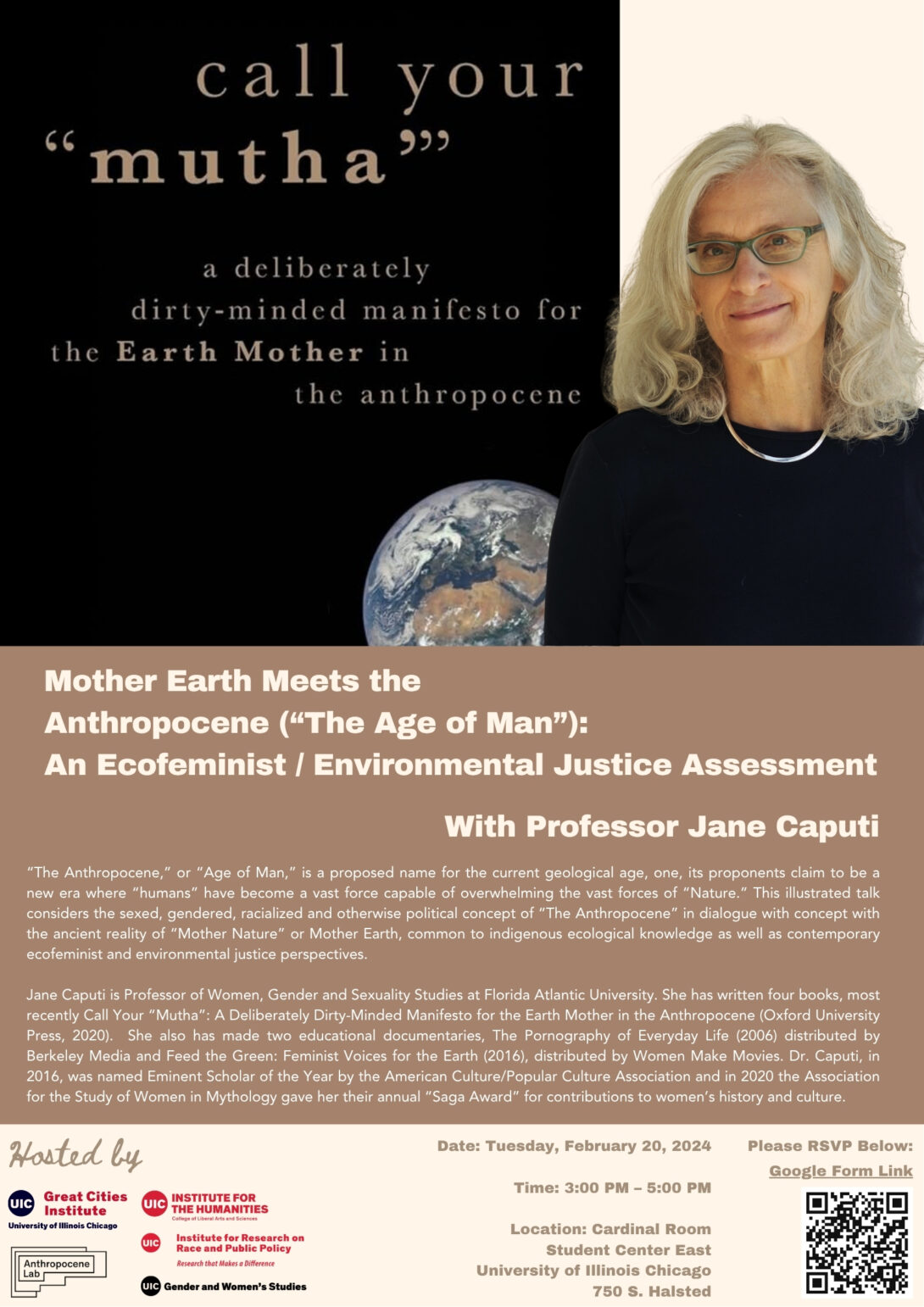
February 20, 2024 | 3:00–5:00 PM
Cardinal Room, Student Center East
University of Illinois Chicago
750 S. Halsted Street, Chicago, IL 60607
On February 20, 2024, the Great Cities Institute at the University of Illinois Chicago (UIC), in collaboration with the Institute for the Humanities, the Institute for Research on Race and Public Policy, the Anthropocene Lab, and Gender and Women’s Studies, hosted a lecture featuring Dr. Jane Caputi, Professor of Women, Gender, and Sexuality Studies at Florida Atlantic University.
Titled Mother Earth Meets the Anthropocene (“The Age of Man”): An Ecofeminist / Environmental Justice Assessment, the lecture examined the intersections of environmental justice, ecofeminism, and the cultural and political implications of the Anthropocene, a proposed geological epoch characterized by humanity’s profound influence on the Earth’s ecosystems.
Drawing from her book Call Your “Mutha”: A Deliberately Dirty-Minded Manifesto for the Earth Mother in the Anthropocene, Dr. Caputi critically examined the gendered, racialized, and political assumptions underlying dominant narratives of human mastery over nature. She explored how these perspectives intersect with histories of environmental exploitation, patriarchal power structures, and social inequality.
The discussion brought Indigenous ecological knowledge into conversation with contemporary feminist theory and environmental justice perspectives, emphasizing the symbolic and material significance of Mother Earth. Dr. Caputi highlighted alternative approaches to humanity’s relationship with the natural world, advocating for ecological responsibility, reciprocity, and respect for the interconnectedness of all living systems.
The event provided an opportunity for students, scholars, and community members to reflect on the relationship between gender, race, environmental degradation, and social justice while considering how ecofeminist perspectives can inform more equitable and sustainable approaches to addressing contemporary environmental challenges.