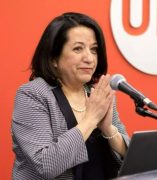
Teresa Córdova, Ph.D.
Director, Professor
Contact
- Building & Room:
- MC 107 Suite 400
- Address:
- 412 S. Peoria St.
- Office Phone:
- 312.355.3803
Email:
CV Download:
About
Teresa Córdova is Director of the Great Cities Institute (GCI) at the University of Illinois Chicago and Professor of Urban Planning and Policy in UIC’s College of Urban Planning and Public Affairs. She received her Ph.D. in Sociology from the University of California, Berkeley. An applied theorist, political economist, and community-based planner, Córdova has spent her career integrating research, teaching, public service, and community engagement. Her work is grounded in a scholarship of engagement that seeks not only to understand the forces shaping communities and cities, but also to build the knowledge, relationships, institutional capacity, and strategies through which people can shape their futures.
For more than five decades, Córdova has studied the relationship between large-scale economic and political change and the experiences of local communities. Beginning with her early research on global economic restructuring, land use, and community conflict, her scholarship has examined how transformations in political economy become visible in neighborhoods: through the movement of capital and industry, changing labor markets, uneven development, environmental burdens, displacement and disinvestment, and struggles over public resources. Across this work runs an enduring concern with how communities respond to structural change and how research, planning, public policy, and collective action can expand their capacity to shape outcomes.
Since becoming Director of the Great Cities Institute in 2012, Córdova has built upon this approach through an extensive program of engaged urban research. GCI links university resources with community organizations, government agencies, policymakers, foundations, and other partners to conduct research and policy analysis, provide data and technical assistance, develop community and economic development strategies, facilitate public engagement, and strengthen the capacity of organizations and communities. Under her leadership, the Institute’s work has addressed youth employment, manufacturing and industrial policy, neighborhood economic development, Latino communities, environmental and climate justice, water and infrastructure, criminal justice barriers to employment, community planning, and the equitable allocation of public and private investment.
A major strand of Córdova’s recent work examines the consequences of economic restructuring for Chicago’s neighborhoods and labor markets. Working with colleagues at GCI and community partners, she has produced a body of research documenting the chronic and concentrated nature of joblessness among Black and Latino teens and young adults and its relationship to the disappearance of industrial employment and other economic opportunities from many Chicago neighborhoods. This work has connected labor-market restructuring to broader questions of neighborhood disinvestment, racial and spatial inequality, violence, workforce development, and economic opportunity. It has also informed her continuing advocacy for rebuilding Chicago’s manufacturing base, strengthening pathways into good jobs, supporting succession strategies that preserve locally rooted firms, and expanding opportunities for Black and Latino workers and entrepreneurs.
Córdova’s longstanding work in community and economic development increasingly focuses on the institutions and public policies through which development is financed and its benefits distributed. In 2026, she co-authored, with Juan González, Matthew D. Wilson, and Jason “Jay” Campos, Chicago’s Runaway Development Tool: Who Paid and Who Gained from 40+ Years of Tax Increment Financing. The report examines more than four decades of Chicago’s use of Tax Increment Financing and places TIF within the larger history of urban economic restructuring, municipal development policy, property taxation, and uneven neighborhood development. This work builds on Córdova’s earlier experience as an elected local official, when she dealt directly with economic development incentives, infrastructure investment, land use, public finance, and long-range planning.
Another major dimension of Córdova’s recent work concerns the changing geography, economy, and civic life of Latino communities. Through GCI’s Latino Research Initiative and partnerships with Latino organizations and policymakers, she has helped develop research intended to strengthen the empirical foundation for Latino policy and community development. Recent projects include Fuerza Mexicana: The Past, Present, and Future of Mexicans in Chicagoland, produced with community partners in 2024; the 2025 Raíces Report: Advancing Equity, Justice, and Community Development; and Raíces 2026: Building Stability to Strengthen Latino Civic Power. These projects examine demographic and geographic change alongside questions of housing, employment, economic development, civic infrastructure, political representation, community investment, and the institutional capacity of Latino communities.
Her recent public scholarship has also returned to questions that have animated her work for decades: the relationship between economic restructuring, racial inequality, public policy, and the capacity of communities to build more equitable futures. In June 2026, she provided invited testimony to Chicago’s Reparations Task Force, drawing upon the history of urban development policy and its role in producing and reproducing racialized patterns of disinvestment and inequality. That same month, she participated in Congressman Jesús “Chuy” García’s Connecting Youth to Jobs panel, bringing her longstanding research on industrial restructuring and youth joblessness into contemporary discussions about federal employment policy. Her recent work on fair-chance employment and social enterprise similarly addresses the institutional barriers confronting people with criminal justice involvement and the potential of community-rooted enterprises to create pathways into stable employment.
Córdova’s scholarship extends beyond Chicago and connects contemporary urban questions with longstanding interests in place, identity, environmental justice, and community resistance. Her publications include work on environmental and economic justice, Chicana feminism, Latino political economy, community-based research, public policy, collaborative community development, resource extraction, and Genízaro identity. Her 2022 co-authored article, “Environmental Justice and The Alliance for a Just Transition: Grist for Climate Justice Planning,” examines the lessons of the environmental justice movement for climate policy and planning. Her chapter on boomtown planning in North Dakota explores the consequences of resource extraction for local communities, while her work on Genízaro identity examines ethnogenesis, historical memory, place, persistence, and resistance. In May 2026, she returned to these themes as a panelist on “Nación Genízara: Ethnogenesis, Place and Identity in New Mexico” at the International Conference on Chicano Literature and Latino Studies at the Universidad de Extremadura in Cáceres, Spain.
Her scholarship is also deeply rooted in the intellectual and political history of Chicana and Chicano Studies. Córdova was involved in the formative development of Chicana feminist scholarship and organizations and has written extensively on Chicana feminism, knowledge production, colonialism in the academy, community engagement, and the relationship between scholarship and social change. In September 2026, the University of Arizona Press published How We Came to Be: An Intellectual Genealogy of Chicanos in Higher Education, which she co-edited with Aida Hurtado, Francisco Hernández, and Avelardo Valdez. Her contributions include the volume’s introduction and the chapter “On Becoming a Chicana Scholar.” The book reflects her continuing interest in understanding how intellectual traditions are produced through movements, institutions, mentorship, community, and the experiences of generations of scholars who entered higher education during a period of profound social transformation.
Before returning to UIC in 2012, Córdova spent twenty-one years at the University of New Mexico, where she was Professor and Chair of the Community and Regional Planning Program and founded and directed the Resource Center for Raza Planning. The Center engaged students directly with communities in research, policy analysis, participatory planning, economic development, infrastructure design, land use, neighborhood development, agricultural preservation, and youth development. That work exemplified an approach Córdova has carried throughout her career: the university as a public institution whose intellectual resources can be mobilized in partnership with communities while simultaneously creating opportunities for students to become thoughtful and effective practitioners.
Her experience also spans multiple terrains of governance and public policy. She served as an elected County Commissioner in New Mexico and has held appointments to local, regional, state, and federal advisory bodies. In Chicago, she chaired the Chicago Plan Commission and has served since 2017 on the Cook County Economic Development Advisory Committee. She served on Governor J.B. Pritzker’s transition committee on Job Creation and Economic Opportunity and Mayor Brandon Johnson’s Transition Subcommittee on Economic Vitality and Equity. These experiences have given her an unusual perspective on the relationship between scholarship and governance: not simply studying public institutions from outside them, but working within them and with communities attempting to influence them.
Córdova has likewise served extensively on civic, community, philanthropic, and academic boards. She is currently Vice President of the Board of AMARA, formerly the Grand Victoria Foundation, and Vice-Chair of the Gus Newport Legacy Project. Her recent service has included the Illinois Humanities Council, the Chicago Community Trust’s We Rise Together initiative, Kennedy-King College’s Community Advisory Committee, Manufacturing Renaissance, and numerous other civic and community organizations. Her academic service has included ten years as Associate Editor of Economic Development Quarterly, membership on the editorial board of the Journal of Planning Education and Research, and service on editorial boards and advisory bodies spanning planning, economic development, Latino Studies, and Chicana/Latina Studies.
Throughout her career, Córdova has moved among the university, community organizations, government, civic institutions, and social movements. Earlier in her career she served on the Berkeley Planning Commission, including as Vice-Chair; participated in the anti-apartheid movement; helped initiate the Empowering Women of Color Conference at Berkeley; and was involved in the formation of Mujeres Activas en Letras y Cambio Social (MALCS) and the Chicana Caucus of the National Association for Chicano and Chicana Studies. In New Mexico, she worked extensively with the environmental and economic justice movement, including the SouthWest Organizing Project and the Southwest Network for Environmental and Economic Justice, and served on the U.S. Environmental Protection Agency’s National Environmental Justice Advisory Committee Subcommittee on Hazardous Waste and Facility Siting.
This history informs Córdova’s understanding of engaged scholarship as more than community service or the dissemination of academic knowledge. It is a way of producing knowledge through sustained engagement with people attempting to understand and transform the conditions in which they live. Her work repeatedly asks how structural forces constrain possibilities for action, how institutional arrangements distribute power and resources, and how communities can develop the knowledge, organization, relationships, and strategies necessary to intervene effectively in those processes.
Córdova is a frequent speaker and moderator at academic, policy, civic, and community forums in the United States and internationally. Recent engagements have ranged from discussions of manufacturing, Latino civic power, housing, philanthropy, environmental justice, and engaged scholarship to international conversations about urban development and planning. In August 2026, she moderated The State of Equity: A Mayors Transportation Roundtable with Chicago Mayor Brandon Johnson and Kansas City Mayor Quinton Lucas, and in December 2025 she moderated Great Cities Institute: 30 Years of Impact, a gathering reflecting on three decades of engaged urban research at UIC.
Her contributions have received numerous academic, civic, and community recognitions. Most recently, UIC honored her with its Senior Community Engagement Award in March 2026 and the Chancellor’s Committee on the Status of Latinos Lifetime Service Award in April 2026. In 2024, Crain’s Chicago Business named her one of its Notable Latino Leaders. Earlier honors include the Sor Juana Legacy Award from the National Museum of Mexican Art, recognition from the Illinois Hispanic Chamber of Commerce as one of its Women Who Inspire Us, and awards recognizing her contributions to community development, planning, teaching, economic development, and public service.
Across these different roles—as scholar, planner, teacher, researcher, public official, institution builder, and community partner—Córdova’s work is connected by a consistent concern with the relationship between structure and human agency. Her career has been devoted to understanding the forces that produce inequality and uneven development while working with others to identify the points at which those forces can be challenged, redirected, or transformed. As Director of the Great Cities Institute, she continues to advance this work by building the capacity of researchers, students, community organizations, policymakers, and public institutions to produce knowledge together and to use that knowledge to shape more equitable urban futures.
Education
Ph.D. University of California, Berkeley, Sociology, 1986
M.A. University of California, Berkeley, Sociology, 1979
B.A. University of Denver, Sociology, 1974