Disparate Disaster Impacts on Undocumented Migrants
Summary
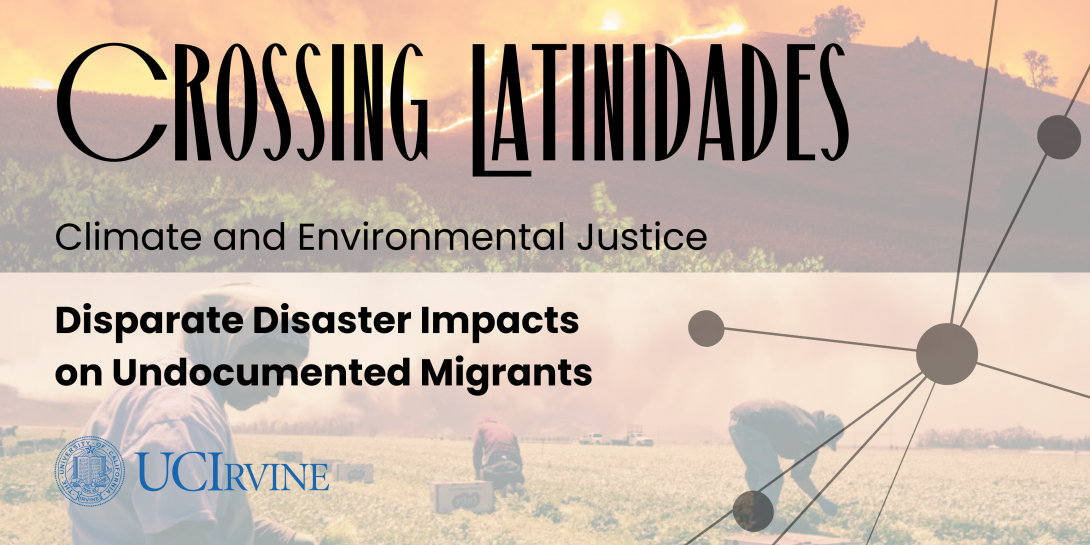
This research project examines how extreme climatic events, such as wildfires, heatwaves, and droughts trigger existing inequalities of socially vulnerable migrants throughout California. It focuses on undocumented Latino/a and Indigenous migrants who are disproportionately vulnerable to climate change partly because they experience poverty, have limited English and Spanish proficiency, and fear deportation. This research uses humanistic methodologies, such as oral stories, StoryMaps, and archival research to document the differential impacts on undocumented migrants to understand how disaster planning and climate adaptation policy may serve to protect the most vulnerable and stigmatized populations.
Working with the social justice organization throughout California, such as the North Bay Jobs with Justice, the project will provide the opportunity for migrant workers to share their diverse experiences of disaster events.
In addition, the project will be integrated into ArcGIS Story Mapping platform, exploring more in depth the humanistic impacts to Latino and Indigenous migrants during wildfire, drought, and heatwave events. StoryMaps use Geographic Information System (GIS) tools to combine geospatial data with photos, video, audio, and text to visualize a theme or sequential events. Such visual data tools can affect policy change, influence opinion, and create awareness. ArcGIS StoryMaps, moreover, can provide policy narratives a stronger sense of place, illustrate spatial relationships, and add visual appeal and credibility to research finding.
These StoryMaps, moreover, will be supplemented with a qualitative policy analysis of emergency management plans and how they incorporate the needs of migrants in their policies on disaster risk reduction, response, and recovery. In addition to a content analysis of plans and policies, the research team will conduct interviews with government officials, employers, migrant rights groups, and migrant workers.
Funding for this project provided by:
- Andrew Mellon Foundation
- Andrew Carnegie Corporation
- National Science Foundation NCAR Early Career Innovators Program
- UCLA Latino Policy and Politics Institute
This project is supported by the Crossing Latinidades Humanities Research Initiative, which ignites cross-institutional and cross-regional comparative research, training of doctoral students, and new scholarship in emerging areas of inquiry about Latina/os. Funded by a grant from the Andrew W. Mellon Foundation, the initiative serves as the anchor of the Alliance of Hispanic Serving Research Universities, a consortium of R1 Hispanic Serving Institutions.
Data and Analysis via ArcGIS Map
Publications
Air quality monitoring and the safety of farmworkers in wildfire mandatory evacuation zones
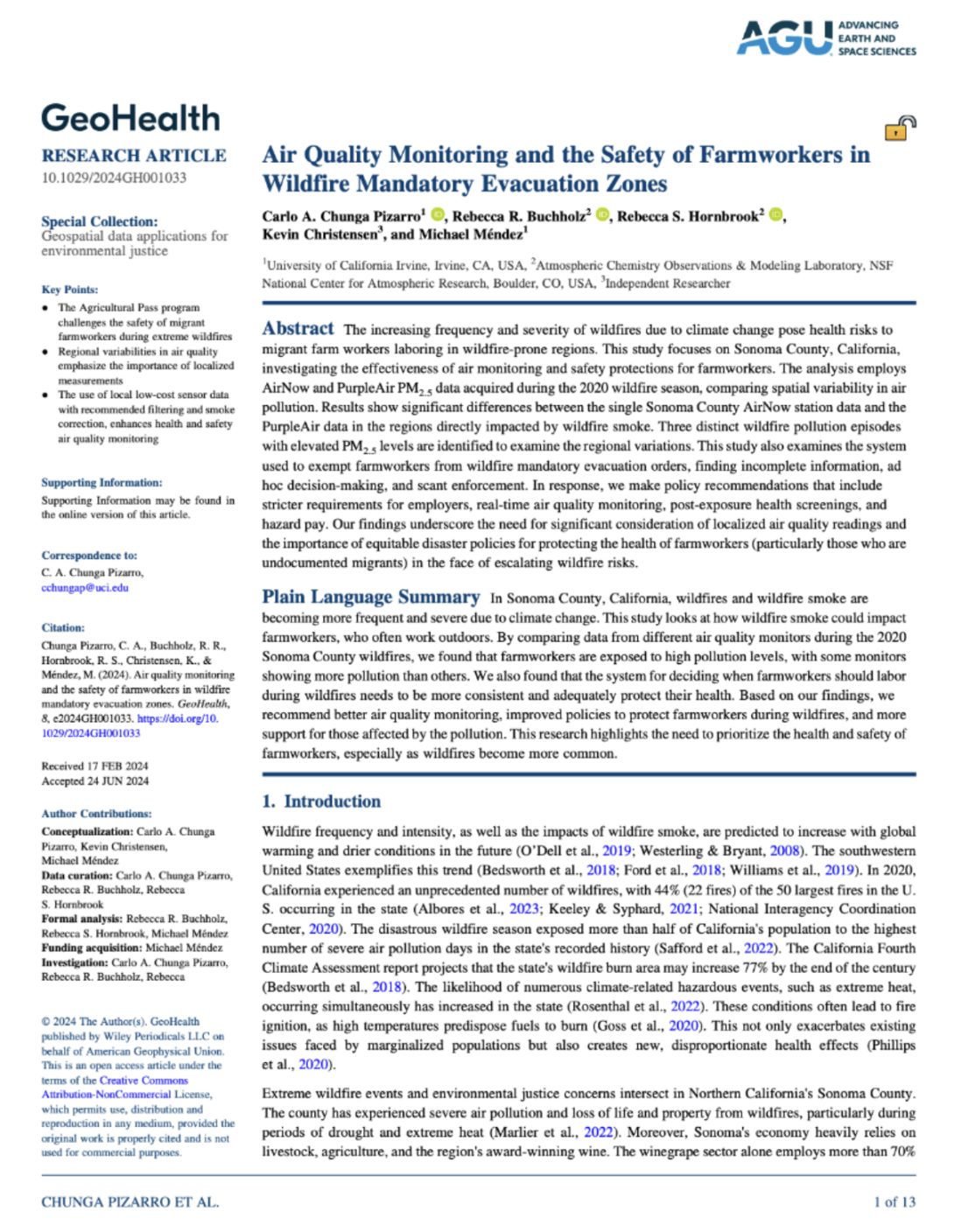
In Sonoma County, California, wildfires and wildfire smoke are becoming more frequent and severe due to climate change. This study looks at how wildfire smoke could impact farmworkers, who often work outdoors. By comparing data from different air quality monitors during the 2020 Sonoma County wildfires, we found that farmworkers are exposed to high pollution levels, with some monitors showing more pollution than others. We also found that the system for deciding when farmworkers should labor during wildfires needs to be more consistent and adequately protect their health. Based on our findings, we recommend better air quality monitoring, improved policies to protect farmworkers during wildfires, and more support for those affected by the pollution. This research highlights the need to prioritize the health and safety of farmworkers, especially as wildfires become more common.
The (in)visible victims of disaster: Understanding the vulnerability of undocumented Latino/a and indigenous immigrants
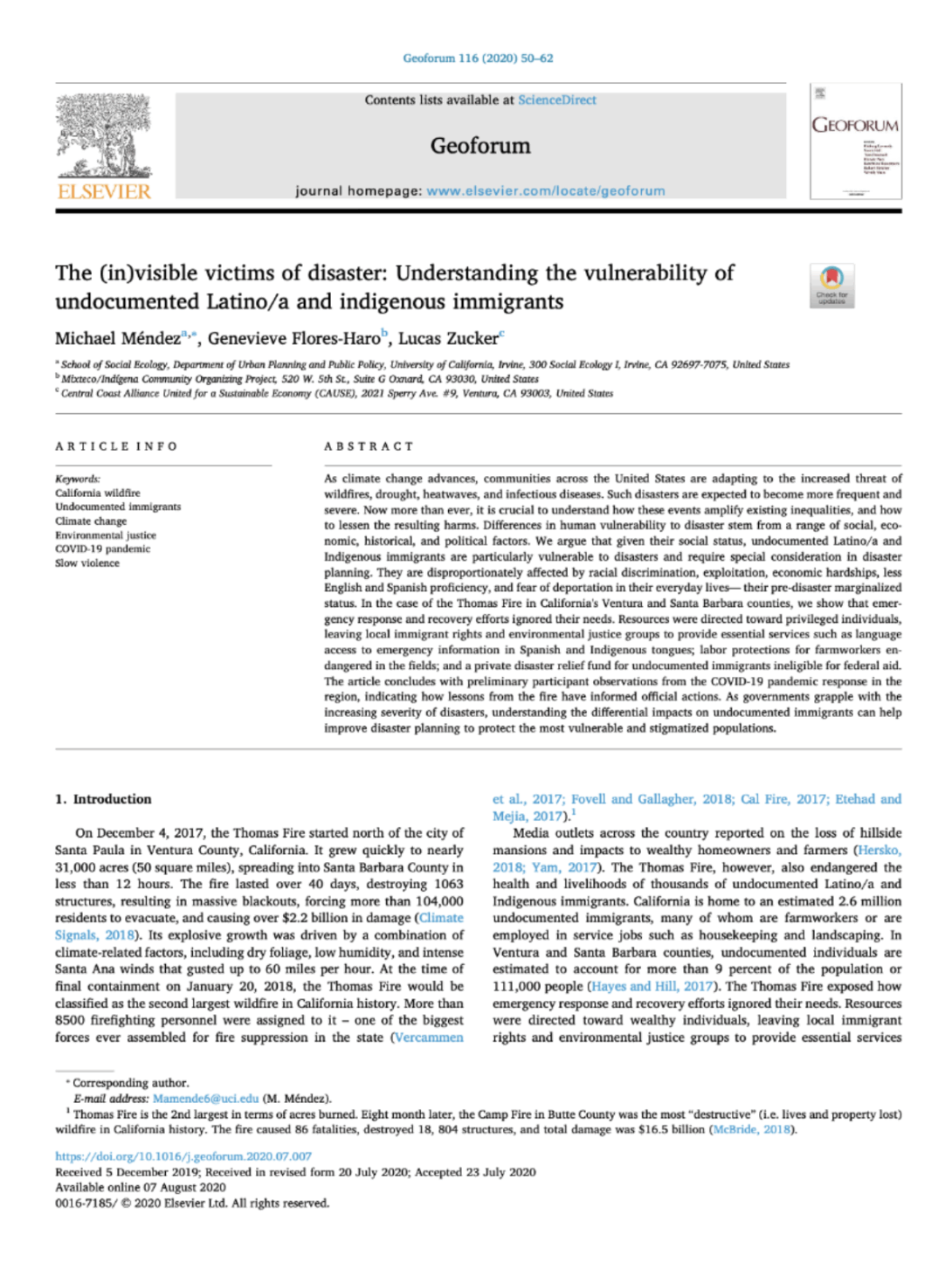
As climate change advances, communities across the United States are adapting to the rising threat of wildfires, drought, heatwaves, and infectious diseases. These disasters are becoming more frequent and severe, making it essential to understand how they deepen existing inequalities. Vulnerability to disaster stems from social, economic, historical, and political factors. Undocumented Latino/a and Indigenous immigrants face heightened risks due to discrimination, exploitation, economic hardships, limited language proficiency, and fear of deportation. During the Thomas Fire in Ventura and Santa Barbara counties, emergency response and recovery efforts largely overlooked their needs. Resources favored privileged residents, leaving immigrant rights and environmental justice groups to provide critical services such as language access, farmworker protections, and private relief funds for undocumented individuals excluded from federal aid. Preliminary observations from the region’s COVID-19 response show how lessons from the fire have informed official actions. As disasters worsen, recognizing differential impacts on undocumented immigrants is vital for more equitable and effective disaster planning.
Video 1: Disaster Impacts On Undocumented Latinos and Indigenous Migrants
Video 2: Adelante | Segment | VOTE 2024 Table Talk and Dr Michael Mendez
Please watch it from 03:00.
Social Media (@MikeMendezPHD)
People
Assistant Professor of Environmental Policy and Planning at the University of California, Irvine
Ph.D. Student in Urban and Environmental Planning and Policy at the University of California, Irvine