Dynamics of Global Mobility
Introduction
The world recently witnessed a major global milestone: more than half of the world’s population is now living in cities. Most population projections for urban areas suggest that the number of people living in cities and their metropolitan regions will continue to grow exponentially. According to the World Health Organization (2013):
The global urban population is expected to grow roughly 1.5% per year, between 2025-2030. By the middle of the 21st century, the urban population will almost double, increasing from approximately 3.4 billion in 2009 to 6.4 billion in 2050.
This exponential urban growth is particularly visible in the rise of mega-cities: cities with a population in excess of ten million people. Now more than ever, people, goods, and capital move across borders, contributing to complex and continuously changing urban environments. This massive growth in cities creates both challenges and opportunities for metropolitan life. GCI is on the forefront of this research, contributing research and policy solutions that keep up with the ever-changing dynamics of global mobility.
Cluster Reports
Below is a collection of reports associated with GCI’s Dynamics of Global Mobility Research Cluster.
Summary
This Language Needs Assessment Report, prepared by Rob Paral at the Great Cities Institute and commissioned by the Illinois Governor’s Office of New Americans, analyzes Illinois’ linguistic landscape using American Community Survey data. It identifies more than one million residents who speak English less than “very well,” highlighting the state’s linguistic diversity and the need for accessible public services. The report documents demographic and geographic patterns of Limited-English-Proficient (LEP) populations and notes recent growth linked to new migration, providing data to guide policy implementation and resource allocation across Illinois.
Summary
The April 2024 research brief The Benefits of Health Coverage for Immigrants in Illinois analyzes the impacts of the state’s Health Benefits for Immigrant Adults (HBIA) and Health Benefits for Immigrant Seniors (HBIS) programs, which provide Medicaid-like coverage to low-income immigrants excluded due to immigration status. Although the programs represented only 0.6% of Illinois’ total state budget in FY2023, the report finds they improve access to preventive care, reduce medical debt and emergency care reliance, support workforce stability, and generate positive economic and social returns for the state.
Summary
The report argues that the current U.S. migration crisis cannot be understood without considering the role of U.S. foreign policy in Latin America. While cities struggle to provide emergency support for arriving asylum seekers, media coverage often overlooks how long-standing economic sanctions and interventions have destabilized countries such as Venezuela, Cuba, and Nicaragua. These policies have contributed to economic hardship and mass migration. The report calls for a more humane U.S. foreign policy that addresses root causes of migration while helping alleviate labor shortages in the United States.
Summary
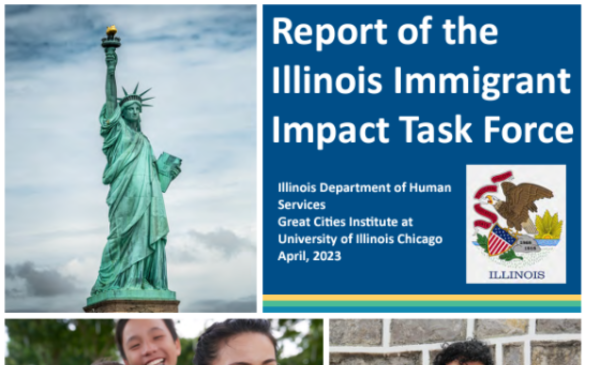
The Immigrant Impact Task Force (IITF), created through SB 2665, is a statewide initiative to assess the needs and future priorities of immigrant, refugee, and limited English proficiency (LEP) communities in Illinois. Composed of 27 representatives from agencies, organizations, and communities across the state, the Task Force developed recommendations to improve services in areas such as citizenship assistance, education, business development, language access, and discrimination prevention. Research and draft development for the report were conducted by the Great Cities Institute at UIC in collaboration with the Illinois Department of Human Services.
Cluster Videos
Mexico City, Mexico: Moises Gonzales’s session, “Myth to Megacity, the Urban Landscape Evolution of Mexico City,” examines how Mexico City’s urban form emerged through layered ecological, colonial, and modern transformations. Framed through ecological urbanism, the talk traces the city from its origins in Lake Texcoco and the Aztec chinampa system to Spanish colonial restructuring, lake drainage, industrial centralization, migration, and informal settlement growth. Gonzales highlights how efforts to restore natural systems must confront the erasure of built environments, neighborhoods, and social fabrics, showing Mexico City as a megacity shaped by constant negotiation between urban development and ecological repair.
Cluster Videos
Wroclaw, Poland: Hana Cervinkova’s session, “City and the Symbolic Politics of Neoliberalism in Central Europe,” examines Wrocław, Poland as a case of neoliberal urban branding and memory politics. She argues that the city markets itself as multicultural, open, and historically diverse while simultaneously containing difficult public memories of its German, Jewish, and socialist pasts. Through examples such as the old Jewish cemetery, the Monument of Shared Memory, and Wrocław’s commodified dwarf symbols, Cervinkova shows how heritage is selectively used for place marketing, tourism, and investment while suppressing deeper democratic engagement with memory, identity, and historical responsibility.
Cluster Videos
Oaxaca, Mexico: Ivan Arenas’s session, “Resisting the Privatization of Public Space: Oaxaca, Mexico,” examines how public spaces become sites of democratic struggle, surveillance, commercialization, and exclusion. Arenas contrasts ideals of the city as a space of public encounter with realities of privatized plazas, regulated protest, tourism-driven development, and consumer-oriented urban space. Focusing on Oaxaca, he shows how the relocation of government offices and commercialization of the historic center weakened traditional protest spaces. The 2006 social movement, however, reclaimed streets through encampments, marches, barricades, assemblies, and protest art, transforming walls into collective sites of political expression and resistance.
Cluster Videos
Medellín, Colombia: Elizabeth L. Sweet’s session examines how internally displaced women in Medellín experience food insecurity as inseparable from violence, health, mobility, and bodily trauma. Drawing on visceral geography, shared cooking events, body-map storytelling, and interviews, Sweet shows how displacement is felt through bodies: broken hearts, empty stomachs, respiratory illness, exhaustion from walking, and memories of violence. Food becomes both a daily struggle and a medium for connection, care, storytelling, and survival. The session argues that urban planning must better account for embodied experiences and move beyond public/private divides to address intimate, structural realities shaping displaced women’s lives in cities today globally.
Cluster Videos
Mumbai, India: Tarini Bedi’s session examines women political brokers in peri-urban Mumbai and their role in shaping slum redevelopment, public housing, and everyday urban politics. Drawing on ethnographic research with working-class women affiliated with the Shiv Sena, Bedi explores how figures such as Shanta and Kanta operate as “matrons,” mediating between residents, political parties, builders, and state agencies. Rather than framing their actions simply as resistance, she describes them as producers of friction, disorder, and negotiation. The session highlights how violence, patronage, gendered authority, material needs, and political presence shape urban development and democratic practice in Mumbai.
Cluster Videos
Rio de Janeiro, Brazil; Mexico City, Mexico; and Chicago, USA: Maria de los Angeles Torres’s session, “Citizens in the Present: Youth Engagement in the Americas,” examines how engaged young people in Rio de Janeiro, Mexico City, and Chicago understand activism, citizenship, rights, and public voice. Drawing on interviews and personal narratives with youth leaders, Torres highlights how young people become engaged through supportive adults, peers, community organizations, and experiences of discrimination or marginalization. Rather than seeing themselves only as “the future,” participants claim agency in the present. The session emphasizes youth knowledge, neighborhood identity, safe organizing spaces, media representation, rights discourse, and the importance of including young people in civic life.
Cluster Videos
Johannesburg, South Africa and Jerusalem, Palestine/Israel: Andy Clarno’s session, “Policing Precariousness in South Africa and Palestine/Israel,” examines how neoliberal inequality and insecurity produce new forms of urban securitization. Comparing Johannesburg and Jerusalem, Clarno shows how marginalized populations face precarious lives while elites respond through racialized fears of crime, terrorism, and disorder. In South Africa, wealthy residents rely on private security, gated neighborhoods, surveillance, and fortified suburbs to police poor Black communities. In Palestine/Israel, the Israeli state, Palestinian Authority, United States, and other actors coordinate security systems that contain Palestinian populations. The session highlights connections between capitalism, policing, militarization, and resistance.
Cluster Videos
Jaipur, India: Sanjeev Vidyarthi’s session examines Jaipur’s effort to become a “world-class heritage city” within broader shifts in Indian urban planning after economic liberalization. Focusing on Jaipur’s master plans, tourism economy, civic pride, and renewed attention to the historic “Pink City,” Vidyarthi traces a shift from postcolonial, state-led planning focused on modern expansion to newer agendas shaped by heritage, private development, regional identity, and local elites. He argues that Jaipur reflects changing relationships between state planning, private actors, newspapers, heritage committees, infrastructure funding, and city identity, raising questions about whether heritage-led planning is transformative or reproduces older power structures.
Cluster Videos
Birmingham, United Kingdom: Deborah Youdell’s session examines Birmingham, U.K. as a superdiverse, supercomplex, and “disassembled” city facing austerity, public service restructuring, and changing forms of local democracy. Drawing on her work with the University of Birmingham’s Public Service Academy, Youdell discusses efforts to connect academic research with city government as Birmingham confronts major funding shortfalls and pressure to redesign public services. She explores tensions between fairness, prosperity, democracy, localism, privatization, co-production, and community responsibility. The session raises critical questions about whether communities can absorb shrinking public services, especially amid rapid demographic change and uneven civic capacity.
Cluster Videos
China: Tingwei Zhang’s session examines contemporary urban design in Chinese cities, focusing on rapid urbanization, large-scale redevelopment, new districts, infrastructure projects, and event-driven investments such as the Beijing Olympics and Shanghai World Expo. He highlights the achievements of high-quality projects often designed by leading international firms, while also questioning uneven development, rural-urban migration, resident displacement, overbuilding, loss of agricultural land, and tensions between modernization and Chinese cultural traditions. The session considers whether China’s urban model can inform other developing countries while asking how physical improvements can better support social equity, sustainability, and quality of life for diverse urban and rural populations alike.
Cluster Videos
Albuquerque, New Mexico, USA: José Rivera’s session examines the concept of water commons in the Rio Grande watershed, focusing on water scarcity, climate change, irrigation traditions, and competing urban, agricultural, tribal, environmental, and economic demands in New Mexico. Drawing on the history of western settlement, John Wesley Powell’s watershed-based vision, acequia systems, and contemporary water planning, Rivera highlights tensions between regional growth, Albuquerque’s dependence on imported Colorado River water, declining snowpack, endangered species protections, and proposed development such as Santolina. The session argues for shared regional approaches to water governance that recognize watersheds, community ditches, and long-standing rights as interconnected commons.
Cluster Videos
Perth, Australia: Clare Mouat’s session examines Perth and Western Australia through the intertwined realities of mining, urban growth, governance, and civic aspiration. Framed as “red earth realities and blue sky thinking,” the talk explores how Perth’s global-city ambitions are shaped by mineral extraction, corporate headquarters, fly-in/fly-out labor, housing pressures, vulnerability, and uneven community impacts. Mouat highlights the Committee for Perth as a civic change organization that uses evidence-based research, philanthropy, and cross-sector collaboration to influence planning and policy. The session argues for grounded, aspirational governance that balances economic opportunity with social responsibility, sustainability, local knowledge, and practical wisdom in Western Australia today.
Cluster Videos
Cairo, Egypt: Atef Said’s session examines Tahrir Square’s role in the making of the Egyptian Revolution of 2011, focusing on how Cairo’s urban geography shaped protest, mobilization, and revolutionary possibility. Drawing on ethnography, interviews, archival research, and his own positionality, Said explores how Tahrir’s location near ministries, parliament, hotels, and symbolic state institutions made it a strategic site for occupation. He also highlights Cairo’s contradictions, marginalized communities, street vendors, police stations, and neighborhood battles as crucial to the uprising. The session ends by questioning how revolutionary public space later became restricted under renewed military rule and surveillance.
Cluster Videos
Albuquerque, New Mexico; San Antonio, Texas; and Los Angeles, California: Moises Gonzales’s session examines the evolution of irrigation-based urban landscapes in the American Southwest, focusing on Albuquerque, San Antonio, and Los Angeles. Drawing on urban morphology, Spanish-Mexican town planning, acequia systems, plazas, common grazing lands, and later American grid development, Gonzales traces how water infrastructure shaped settlement, land use, and cultural identity. He shows how irrigation landscapes were preserved, erased, buried, or rediscovered as cities modernized. The session highlights tensions between efficiency-driven planning and cultural memory, arguing that restoring rivers, acequias, plazas, and historic landscapes can help cities reconnect with identity, ecology, and community values.
Cluster Projects
International Trade and Community Development
Great Cities Institute and the Republic of Ecuador’s Minister of International Trade, Diego Aulestia, formed a partnership to assess the connections and possibilities between international trade and community development. The Great Cities Institute produced a research report to him, titled: “Exports, Policy Choices, and Economic Growth for Ecuador: Achieving the Plan Nacional del Buen Vivir” (PNBV). The report presented policy options for Ecuador’s goals for “Strategic Insertion in the World” and for establishing a solidarity-based and sustainable socio-economic system. As part of its partnership with the Ministry, GCI hosted the Minister and his entourage multiple times and members of GCI staff traveled to Ecuador to attend meetings, conduct interviews, tour key projects, and present research at two universities.
Global Health & Well-Being Research Seed Grant Program
Through the UIC Global Excellence Task Force, the Chancellor’s Office created the Global Health seed fund. Adminstered by the UIC College of Medicine’s Center for Global Health with the help of GCI, the annual seed grant program is designed to foster new trans-disciplinary and mixed and multiple methods research in global health and well-being at UIC. In particular, these grants will encourage new pilot research with a substantial likelihood of gaining external funding or that can be completed with a limited budget.
Ending Violence against Arab Women: Transnational Approaches across Four Cities
While a GCI Faculty Scholar, Nadine Naber worked on her book, Ending Violence against Arab Women: Transnational Approaches across Four Cities. Overall, her work illustrates that state violence (poverty and militarism) are themselves forms of gender violence and that state violence and individualized forms of violence magnify each other. The contributions based on her work are more urgent than ever before since gender violence is on the rise in the Arab region. Moreover, Arab women living in major U.S. cities such as Detroit and Chicago have virtually no resources for responding to the problem of gender violence. Dr. Naber’s contributions will assist those developing strategies for ending violence that are actually relevant to the complex realities of Arab women’s lives.
Immigration
GCI contributes to and participates in the multi-faceted programs and research at UIC on topics of immigration, displacement, and the formation of diaspora communities.
New African Diaspora in Chicago: Memories, Maps, and Communities
GCI Faculty Scholar Lynette Jackson’s project, “New African Diaspora in Chicago: Memories, Maps, and Communities,” has two major objectives. The first is to respond to the paucity of detailed and in-depth studies on Chicago’s growing African immigrant and refugee communities, specifically those coming from the following three regions of the African continent: Northeastern Africa (Sudan, Somalia, Eritrea and Ethiopia), Mano River States (Liberia, Sierra Leone and Guinea) and Great Lake Region (Burundi, Rwanda and Democratic Republic of Congo.) The second is to interrogate the way in which the protean term African diaspora is deployed, particularly in the media and by various non-governmental, national and multilateral organizations.
Chicago Youth in the Survival Sex Economy: Sexualities, Poverty, Race, and the Law
GCI Faculty Scholar Laurie Schaffner is taking a closer look at underlying assumptions about youth, sex, mortality, and the law. She is analyzing 250 qualitative field interviews with self-identified young people who had ever traded sex for money or survival needs in the streets of Chicago during the time period 2011 to 2013 as a part of a national seven-city study of the commercial sexual exploitation of children, funded by the Office of Juvenile Justice and Delinquency Prevention of the U.S. Department of Justice. Through this, she intends to decipher popular vocabulary as we seek solutions to the problem of poor youth exchanging sex in the streets, clubs, strolls, and cars in Chicago. Her research captures a rich sociological view of an issue that affects millions of families and communities around the world, across the nation, and here in Chicago.
Trans-Urban Imaginaries of Transport: Urban Labor and the Taxi Trade in Mumbai and Manila/Singapore Style
GCI Faculty Scholar Tarini Bedi, assistant professor of Anthropology, brings the social into transport research, exploring the social, cultural, and economic life of transport through the networks of those who drive for a living in the transport and motoring trades, specifically in the taxi-trade. The project seeks to understand how taxi-drivers in the model city (Singapore) and the two modeled cities (Mumbai and Manila) respond to, adapt to, and shape the changes to their industry. It seeks to contribute to the understanding of comparative Asian urbanism, transformations of labor structures in Asian contexts of globalization, and the comparative study of the social networks of labor that surround transport infrastructures. This project seeks to explore the convergences, flows, distinctions, and frictions that present themselves in the efforts to corporatize the taxi trade in these three cities.
Walled Cities
Over the last twenty years, the landscapes of cities throughout the world have been transformed by the construction of walled enclosures. What explains the proliferation of these 21st century separation walls? GCI Faculty Scholar Andy Clarno, assistant professor of Sociology and African American Studies, attempts to answer this question through an analysis of walled enclosures in Johannesburg and Jerusalem. What explains the different forms that these enclosures take? To carry out this research, Clarno brings together the tools of comparative urban ethnography and comparative historical sociology. His research focuses on: the relationship between neoliberal restructuring and the political transitions in each state, the growth of marginalized populations, the politics of security, and the production of walled enclosures.
Asia and China Research Program
GCI established the Asia and China Research Program in 2007, led by Professor Tingwei Zhang. The Program was initiated with an agreement between GCI and Guangxi Institute of Architectural Design and Research (GIADR), Guangxi Province in China.
The agreement provides funding for research and exchange between GCI and GIADR, around issues of importance to Southeast Asian countries, especially China. Collaborative research focused on economic, political, environmental, urban planning, and architectural issues, as they provide opportunities for exchange of ideas that mutually benefit both universities.
With the extension of the 2009 agreement between GCI-ACRG and Guangxi Hualan Planning and Development Consulting Group, a new project started in February 2014 on the comparative study of economic transition and spatial reorganization in the city of Nanning, China and Chicago. The project explores strategies employed by the municipal governments of the two cities in the globalization era.
Learning and Exchange
In October 2013, Great Cities Institute launched its research cluster, Dynamics of Global Mobility, with an interdisciplinary symposium of UIC and international scholars, entitled, Cities Across the Globe. A second symposium was held on April 29, 2015. Both symposia served as the jump off for a GCI research group of UIC, national, and international scholars that are focusing on international cities, providing a space for inter-disciplinary dialogue on challenges and successes on a global scale. This GCI Working Group will result in a series of publications the first of which is an edited volume from Routledge Press on disassembled cities. To check out videos from the 2013 and 2015 symposia, visit the Cities Across the Globe media page.
GCI regularly hosts international visiting scholars and guests – both individuals and delegations. In the 2012-2013 academic year, GCI received visitors from Chile, Russia, South Korea, and United Kingdom. In 2013, the GCI sponsored conference on Participatory Budgeting drew participants from over 70 cities in 17 countries. In the 2013-2014 academic year, we hosted international visitors from Turkey, Poland, Russia, United Kingdom, Ireland, Mexico, among others. Since 2014, guests and delegations to GCI have traveled from Australia, Canada, China, Colombia, Cuba, Ecuador, Egypt, France, Great Britain, India, Indonesia, Ireland, Liberia, Mexico, the Netherlands, New Zealand, Nigeria, Russia, Spain, South Africa, and Turkey. For six consecutive years, a delegation of civic leaders from Russia has spent a day at GCI. The visit is organized and supported by Open World Leadership Center (Library of Congress), American Council of Civil Society in Russia, Inc., Moscow School of Civic Education, and UIC Great Cities Institute. The Moscow School of Civic Education, a non-governmental organization, was established in 1993 “to promote the development of civil society in Russia.”
In 2013, GCI hosted Elif Kalan from Turkey, as part of U.S. Department of State’s Professional Fellows Program. Eon O’Neil was a visiting scholar from Dublin. Catherin Durose, from the University of Birmingham, UK spent the summer of 2014 with us while she conducted her research. For two months in Spring 2016, Laura Pin was a visiting scholar from Canada. For four weeks in Fall 2016, GCI hosted Santiago Martinzez Jaramillo, from Colombia, a fellow with World Chicago’s Young Leaders of the Americas Initiative. Though not international, Mérida M. Rúa, Director of Latino Studies at Williams College, spent a year in residence at Great Cities Institute.
GCI also travels to interface with partners in other countries. These visits typically include formal presentations by GCI staff at academic colloquia, as exemplified in visits to Birmingham, UK; Istanbul, Turkey; and Guayaquil and Quito, Ecuador. Most recently, a GCI delegation attended UN Habitat III gathering in Quito Ecuador, a major international gathering of over 35,000 attendees, during which time, New Urban Agenda, also known as the Quito Declaration, was adopted.