Energy & the Environment
Introduction
Accelerating energy consumption, climate change, resource extraction and the demands of a growing global population have put stress on the natural environment causing climate change, deforestation, ecosystem damage, and polluted natural environments. The impact of environmental degradation is not evenly absorbed across nations, regions, or communities and often, marginalized groups most ill-equipped to cope with environmental issues, bear the greatest burdens.
GCI’s Energy and the Environment Research Cluster supports research pertaining to local and global issues of environmental justice, natural resource preservation, the relationship between the natural and built environment, and policies that promote a sustainable future. GCI’s work on Energy and the Environment considers the ramifications of environmental degradation and supports progressive policies that promote sustainable community development.
Cluster Reports
Below is a collection of reports associated with GCI’s Energy & the Environment Research Cluster.
Summary
Prepared by the Great Cities Institute and UIC’s Freshwater Lab for the Metropolitan Water Reclamation District (2023), this report examines the growing imbalance between flooding and water scarcity in northeastern Illinois. It explores water recycling as adaptive infrastructure to address climate pressures, uneven water geography, and rising demand. The interdisciplinary study analyzes technical, environmental, and public health considerations, provides a cost-benefit analysis, and outlines policy and planning strategies. It concludes that large-scale water reuse can help balance flooding and drought while supporting economic development and long-term water sustainability.
Summary
This Great Cities Institute report presents a planning framework to address environmental, social, and economic challenges along the Calumet River on Chicago’s Southeast Side. Covering South Chicago, East Side, and South Deering, the study combines demographic data, land use analysis, and community input gathered through interviews and engagement events. Residents emphasized public health, environmental remediation, equitable access to resources, and local economic development. The report outlines strategies for pollution cleanup, expanded public health resources, improved housing and transit access, and sustainable economic development tied to the Calumet Industrial Corridor and Commercial Avenue.
Summary
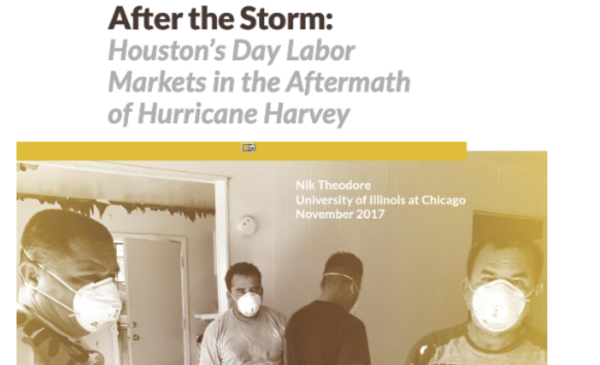
This report examines the working conditions of day laborers involved in Hurricane Harvey recovery efforts in Houston. Based on a survey of 361 informally employed construction workers conducted weeks after the 2017 storm, the study highlights the critical role immigrant day laborers play as “second responders” in debris removal, demolition, and rebuilding. Findings reveal widespread substandard labor conditions affecting wages, health, and safety. The report underscores the vulnerability of this workforce and offers policy recommendations to improve labor protections and working conditions during post-disaster recovery operations.
Cluster Projects
Great Cities, Great Rivers Initiative
Great Cities Institute has embarked on its Great Cities, Great Rivers Initiative to promote innovation districts and community planning for economic and community development in the regions of the Calumet River and the South Branch of the Chicago River. By building partnerships and providing technical assistance, GCI works alongside stakeholders in the region to produce community plans and provide technical assistance and analysis.
National Park Service – Rivers, Trails and Conservation Assistance (RTCA) Program partners with GCI: Throughout 2016 the National Park Service (NPS) is celebrating the 100th anniversary of its founding. Heralded by writer and historian Wallace Stegner as “the best idea we ever had,” the National Park Service is the federal agency responsible for overseeing more than 84 million acres of wilderness, national monuments, protected lakeshores, and scenic rivers and trails. Since April 2016, a Community Planner from the National Park Service – Rivers, Trails, and Conservation Assistance (RTCA) Program has been located within the GCI office.
Sustainable Coastal Community Development Initiative
The Sustainable Coastal Community Development initiative of the Illinois-Indiana Sea Grant College Program supports and guides this GCI program, providing academic research and technical assistance to local governments and planning agencies within northeastern Illinois and northwestern Indiana.
Retired GCI Fellow and Associate Professor of Urban Planning and Policy, Martin Jaffe, was the principal investigator and coordinator of this research and worked in collaboration with the Chicago Metropolitan Agency for Planning, the Northwest Indiana Regional Planning Commission, non-profit organizations (such as Chicago Wilderness, the Metropolitan Planning Council, and the Center for Neighborhood Technology), as well as federal, state and local officials. Sea Grant’s Sustainable Coastal Community Development initiative addresses a wide variety of emerging environmental issues affecting the Chicago metro area, such as regional water supply planning, innovative approaches to water quality management (including the use of computer models to identify environmental “tipping points” for urban waterways), the use of green infrastructure for urban stormwater management, habitat protection, and climate change adaptation at the state, regional and local levels of government. Illinois-Indiana Sea Grant is committed to both protecting and enhancing the wide range of environmental and ecosystem services provided to communities in the lower Lake Michigan basin.
Feasibility & Efficiency Analysis of Neighborhood-Based Sustainable Food Waste Management
In “Feasibility & Efficiency Analysis of Neighborhood-Based Sustainable Food Waste Management” Professors Ning Ai and Isabel Cruz compare data from previous food waste studies conducted at UIC and across the Chicago metropolitan region, integrating state-of-art knowledge from the distinct fields of urban planning and computer science. Their comparison includes consideration of differences in the methodologies of these studies in order to further refine models and parameters for future studies. In addition, they expand Dr. Cruz’s framework for spatial and temporal data integration, GIVA, in order to address the unique challenges of the project.
Environmental Justice
Great Cities Institute supports the work of environmental justice organizations by providing technical support and by hosting meetings. GCI hosted Little Village Environmental Justice Organization (LEVJO), Natural Resources Defence Council, and VOCES Latino Leadership in Action to discuss the impact of Latinos on environmental justice and climate change action in the U.S. on March 7, 2014. In Fall 2016, GCI hosted the newly formed Midwest Network for Environmental Justice.