Giving Thanks for the Opportunity to Contribute
Summary
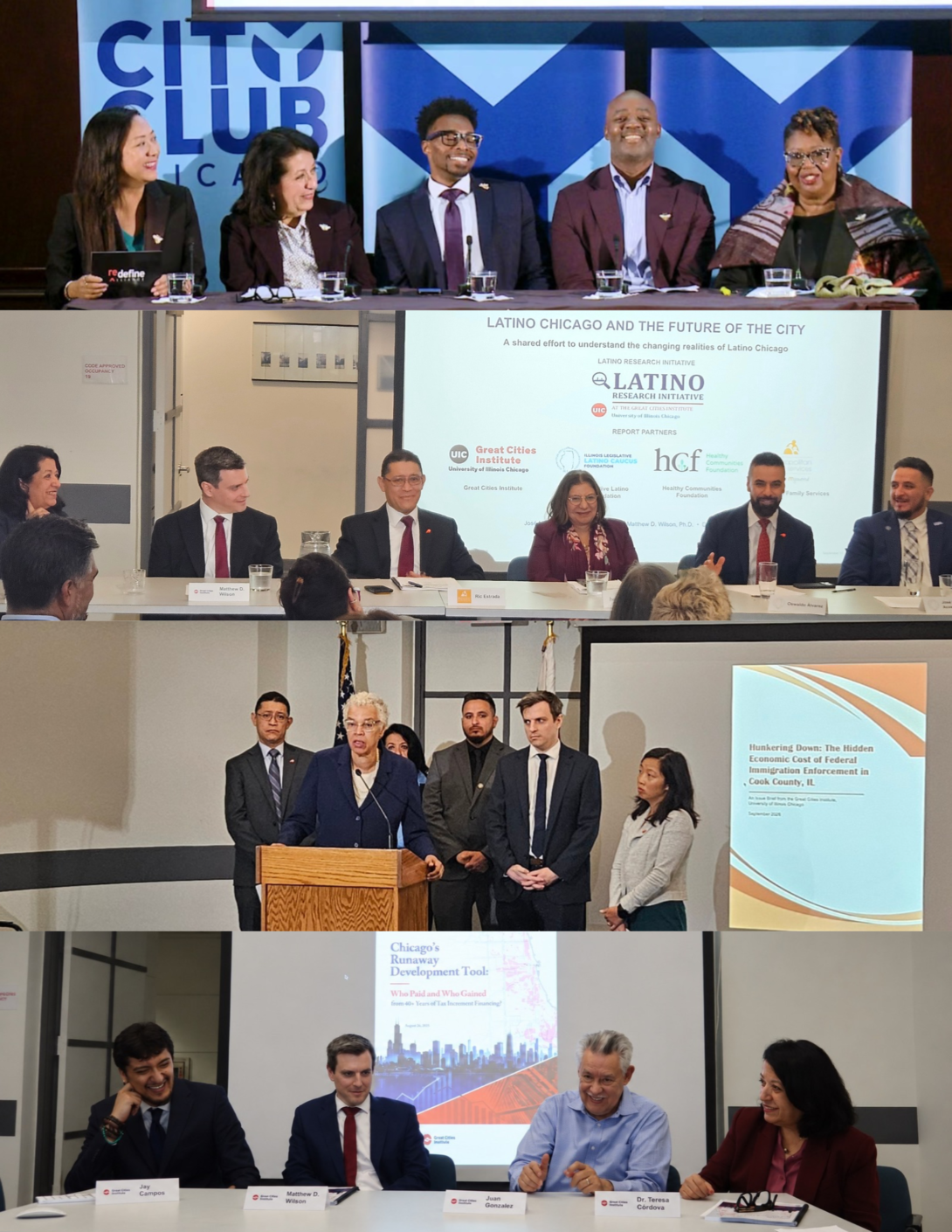
As we approach Thanksgiving, we at the Great Cities Institute (GCI) have much for which to be grateful. Above all, we are thankful for the opportunity to do work that we hope matters – research and analyses that contributes to a deeper understanding of the challenges facing our communities, informs public policy, and supports efforts to create a more equitable and just society.
We are especially grateful for the relationships that make this work possible. We appreciate our many partnerships with community organizations, public agencies, policymakers, foundations, fellow scholars, and residents who generously share their knowledge, experiences, and insights. We are fortunate to work alongside people who are deeply committed to improving the conditions of their communities and expanding opportunities for others.
At Great Cities Institute, we believe that research has an important role to play in public life. By bringing rigorous analysis together with the knowledge and experiences of communities, we seek not only to document social and economic conditions but also to contribute to informed public dialogue and meaningful action.
Below, we share highlights of our work over the past few months, with links to the full reports. Addressing some of the most pressing issues facing Chicago and the region, this research reflects countless hours of data collection, analysis, collaboration, and engagement with complex public issues. More than published findings, these reports represent our ongoing commitment to producing research that informs public dialogue and contributes to meaningful change.
Recent Research and Reports
Authors/Contributors: Timothy Imeokparia and Kyle McFarren
Released: October 20, 2026
This report examines the persistent barriers to employment faced by individuals with criminal justice involvement and highlights the importance of social enterprises in creating pathways to economic opportunity. Focusing on Chicago’s North Lawndale neighborhood and the work of the North Lawndale Employment Network, the research documents the enormous social and economic costs of repeated incarceration while demonstrating the effectiveness of community-based employment and reentry programs. The findings make a compelling case for investing in fair-chance hiring, workforce development, and comprehensive support services as strategies for strengthening individuals, families, and communities.
2. Chicago’s 2027 Budget Engagement Report
Authors/Contributors: Thea Crum, Kyle McFarren, Mari Villa, and Katherine Faydash
Released: October 14, 2026
Developed by GCI’s Neighborhoods Initiative in partnership with the City of Chicago’s Office of Budget and Management and Mayor’s Office of Community Engagement, this report documents residents’ priorities for the City’s 2027 budget. Through public meetings, surveys, and participatory budgeting exercises, Chicagoans shared their perspectives on essential services, neighborhood investment, revenue options, and the difficult choices facing city government. The report demonstrates the importance of incorporating residents’ voices into public decision-making, particularly when fiscal challenges require difficult tradeoffs.
3. Latino Chicago and the Future of the City
Authors/Contributors: José Miguel Acosta-Córdova, Matthew D. Wilson, and David Adrian Segovia
Released: September 17, 2026
Building on GCI’s 2017 Latino Neighborhoods Report, this comprehensive study examines demographic, economic, and geographic changes in Chicago’s Latino communities. The report documents the growing importance of Latinos to Chicago’s population, workforce, commercial corridors, and economic future, while also examining persistent challenges related to housing, transportation, environmental conditions, and unequal access to resources. Developed in collaboration with the Illinois Legislative Latino Caucus Foundation, Healthy Communities Foundation, and Metropolitan Family Services, the report underscores the importance of policies and investments that recognize the diversity, contributions, and changing geography of Latino Chicago.
4. Hunkering Down: The Hidden Economic Cost of Federal Immigration Enforcement in Cook County, IL
Authors/Contributors: Matthew D. Wilson, T. William Lester, and José Miguel Acosta-Córdova
Released: September 8, 2026
This timely study examines the economic consequences of heightened federal immigration enforcement on commercial activity throughout Cook County. Using mobility and consumer activity data, the researchers estimate that changes in shopping and dining patterns associated with increased enforcement corresponded to approximately $1.26 billion in foregone retail and restaurant activity over a year. The findings demonstrate that immigration enforcement has consequences extending beyond immigrant families and neighborhoods, affecting businesses, local tax revenues, and the broader regional economy. The report contributes important evidence to public discussions about immigration policy and economic well-being.
Authors/Contributors: Juan González, Matthew D. Wilson, Teresa Córdova, and Jason “Jay” Campos
Released: August 26, 2026
This extensive examination of more than four decades of Tax Increment Financing (TIF) in Chicago asks fundamental questions about who benefits from public development subsidies and who bears their costs. Analyzing the distribution of TIF revenues, expenditures, and development outcomes, the report finds that the program has disproportionately benefited downtown and nearby areas while placing additional burdens on property taxpayers. It calls for greater transparency, accountability, and reforms that better direct public resources toward historically disinvested neighborhoods and essential public services. The report has generated considerable public discussion about the future of economic development policy in Chicago.
6. Options for Chicago’s Financial Future: Final Report
Authors/Contributors: Chicago Financial Future Task Force, with contributions from GCI’s Thea Crum, chair of its Community Insights Subcommittee
Released: July 15, 2026
This report examines Chicago’s long-term fiscal challenges and presents options for strengthening the City’s financial future. GCI contributed to the Task Force’s work by leading a community engagement process that included surveys, focus groups, and deliberative town halls. Through this process, residents shared their perspectives on public services, affordability, neighborhood priorities, and fiscal responsibility. The resulting findings demonstrate the importance of considering community experiences and priorities alongside financial analysis when evaluating the City’s fiscal choices.
A Special Milestone: Launching the John Hagedorn Annual Lecture Series
Another occasion for gratitude this fall was the launch of the John Hagedorn Annual Lecture Series, honoring the life, scholarship, and enduring legacy of our dear friend and colleague, Dr. John Hagedorn. John was a longtime Great Cities Institute fellow whose groundbreaking research challenged conventional understandings of gangs, violence, and urban inequality, while emphasizing the importance of understanding people within the broader social and economic conditions shaping their lives. The inaugural lecture, held on October 7, featured Dr. Avelardo Valdez discussing his new book, Homeboys Forever: The Lifetime Consequences of Gang Membership, in conversation with Dr. Kathryn Bocanegra of UIC’s Jane Addams College of Social Work. We are especially grateful to John’s family, colleagues, friends, and the many participants who helped make this inaugural gathering possible. Through this annual lecture series, we hope to carry forward John’s commitment to engaged scholarship, social justice, and research that recognizes the humanity and dignity of communities too often marginalized or misunderstood.
At a time when communities face significant economic and political uncertainty, we remain committed to producing research that helps people understand the forces shaping their lives and strengthens their capacity to shape their own futures.
This Thanksgiving, we give thanks for the privilege of doing this work, for the people with whom we do it, and for the opportunity to contribute, in whatever ways we can, to building more equitable, inclusive, and thriving communities.
Gratitude for the People Behind the Work
We are deeply appreciative of the dedication and intellectual contributions of our researchers, staff, students, and collaborators. We are equally grateful to the organizations, public institutions, and community partners who work with us, challenge us, and help ensure that our research remains relevant to the issues that matter in people’s everyday lives.
We also recognize the importance of the University of Illinois Chicago as a public research university that provides an institutional home for engaged scholarship and supports the connection between academic research and the broader public good.
At a time when communities face significant economic and political uncertainty, we remain committed to producing research that helps people understand the forces shaping their lives and strengthens their capacity to shape their own futures.
This Thanksgiving, we give thanks for the privilege of doing this work, for the people with whom we do it, and for the opportunity to contribute, in whatever ways we can, to building more equitable, inclusive, and thriving communities.
From all of us at the Great Cities Institute, we wish you and your loved ones a peaceful and meaningful Thanksgiving.